
Recubrimiento para pisos de talleres mecánicos y automotrices
El piso de un taller no falla por el tránsito de personas. Falla por cuatro cosas: llantas calientes estacionadas encima, aceite y líquido de frenos que se quedan sobre él, torres de soporte y gatos de transmisión que concentran el peso en unas cuantas pulgadas cuadradas, y herramientas que se caen. Un recubrimiento elegido para una sala no va a sobrevivir a ninguna de ellas.
Levantamiento por llanta caliente, y por qué se pelan los recubrimientos baratos
Esta es la falla que todo dueño de taller ha visto. Un carro llega de la calle con las llantas todavía calientes, se estaciona, y el hule queda apoyado contra el piso mientras se enfría. Los recubrimientos blandos o delgados se plastifican con ese contacto y se adhieren a la llanta con más fuerza que al concreto. Cuando el carro sale, el recubrimiento se va con él en parches enroscados.
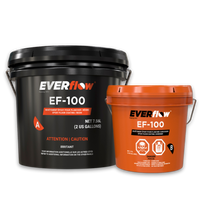
Dos cosas lo evitan: el espesor de película y la química. EF-100 es 100% sólidos, así que nada se evapora de la cubeta y toda la mezcla se convierte en piso. Eso da una película de desgaste real en una sola pasada, que cura a 6,200 psi a compresión y 5,500 psi a tensión, con una pérdida por abrasión Taber de 0.1 g (CS-17, ASTM D4060). Un recubrimiento delgado de un componente, de los que venden en la ferretería, es una fracción de esa película y no tiene ninguna oportunidad contra una llanta caliente.
El sistema que aguanta en una bahía de trabajo
Aplique dos capas. La base epóxica de 100% sólidos hace el trabajo estructural y se adhiere a la losa. Encima, una capa de desgaste poliaspártica recibe el castigo diario y protege el color de abajo.
EF-290 es un transparente de 90 por ciento sólidos que se desgasta a 0.03 g de pérdida Taber, cerca de un tercio de la capa base, así que la capa que usted pagó para dar color se mantiene intacta. EF-280 cubre más área por kit, unos 600 pies cuadrados por kit de 3 galones, lo que lo convierte en la capa de desgaste económica cuando recubre varias bahías a la vez. Ambos están en la línea de capas de acabado poliaspárticas.
Aceite, refrigerante y líquido de frenos
El objetivo de sellar la losa es que los derrames se queden encima del piso en lugar de penetrar en el concreto. El concreto desnudo es poroso. Una vez que el aceite entra, ya no sale: mancha para siempre y afecta la adherencia de cualquier recubrimiento futuro. Un piso sellado de 100% sólidos le permite limpiar un derrame antes de que se vuelva una marca permanente.
Limpie los derrames pronto en lugar de dejarlos reposar. Si su taller maneja químicos agresivos más allá de los fluidos automotrices normales, envíenos la lista antes de comprar, porque la respuesta correcta puede ser otro sistema.
Cómo mantener las bahías abiertas
El tiempo de bahía perdido suele costar más que el recubrimiento. La química de curado rápido es la manera de acortarlo. EF-150 acorta el tiempo de espera para la siguiente capa sobre la base, y EF-290 admite otra capa en 2 a 4 horas, tránsito peatonal en 3 a 6 y tránsito vehicular en aproximadamente un día.
La mayoría de los talleres no cierran por completo. Rotan: sacan los elevadores y el equipo de una o dos bahías, desbastan y recubren, y siguen con las demás. Planee la secuencia según los anclajes de los elevadores y los drenajes antes de empezar, no después de la primera aplicación.
Preparación, elevadores y drenajes
Desbaste con diamante hasta un perfil abierto cercano a ICRI CSP-2 para que la capa base se ancle en el concreto. Las zonas viejas empapadas de aceite necesitan desengrase antes de desbastar, o la contaminación solo se reparte por todos lados. Haga un borde limpio alrededor de las bases de los elevadores y de los drenajes en lugar de recubrir hasta ellos de forma irregular, porque esos bordes son lo que la gente nota.
Con el metraje de un taller, esto es trabajo de equipo en serio. Vea la línea de pulidoras de pisos y combine una con un extractor de polvo para mantener el polvo de sílice fuera del aire y lejos de los vehículos de sus clientes. Las máquinas se cotizan por pedido, así que díganos los pies cuadrados y le especificamos el equipo.
Cómo dimensionar el trabajo
Un kit EF-100 de 3 galones cubre de 150 a 200 pies cuadrados como capa base. Las capas de imprimante y de acabado rinden distinto, así que calcule cada capa con la guía de rendimiento. Mida el área real que va a recubrir, restando la huella de los elevadores y las bases de los equipos. La guía de rendimiento explica las cuentas, y el cálculo de materiales para contratistas arma una lista completa capa por capa.
Preguntas frecuentes
¿Un piso recubierto se pone resbaloso con aceite?
Un piso liso de alto brillo con aceite encima es resbaloso, igual que cualquier otra superficie sellada. Donde eso preocupa, esparza escamas sobre la capa base para dar textura, o pregúntenos sobre agregar aditivo antideslizante a la capa de acabado. Los talleres que lavan los pisos con frecuencia deben planear la textura desde el principio.
¿Puedo recubrir sobre un recubrimiento viejo de taller?
Solo si sabe qué es y sigue bien adherido, y aun así necesita abrasión mecánica. En la mayoría de los pisos viejos de taller es más rápido quitarlo desbastando que hacer pruebas y arriesgarse. Si ya hay parches levantándose, ese recubrimiento le está dando la respuesta.
¿Y la lavadora de piezas y el área de baterías?
Menciónenos esas zonas específicamente. Químicos concentrados en una esquina requieren una especificación distinta al resto del piso, y sale más barato planearlo que repararlo.
Hable con un experto en recubrimientos
Díganos cuántas bahías tiene, los pies cuadrados, qué fluidos recibe el piso y cuánto tiempo puede mantener las bahías cerradas. Nosotros especificamos el sistema y armamos la lista de materiales. Llame al (800) 413-1427 o use la página de contacto.