
Showroom & Retail Metallic Epoxy Floors
In a warehouse the floor is infrastructure. In a showroom it is part of what you are selling. A metallic epoxy floor gives a retail space, lobby, or dealership something a tile floor cannot: an unbroken surface with real depth in it, no grout lines running through the sightline, and a finish that reads custom because it is. No two pours come out the same.
What actually makes a metallic floor look expensive
Three things, and only one of them is color.
- Depth. Metallic pigment suspends and moves inside a clear resin while it cures. You are looking into the floor, not at it. That effect needs film thickness to develop, which is why a high-build clear base matters more than the pigment you pick.
- Movement. The veining and cloud patterns come from how the pigment is dispersed and worked. This is a technique, and it is learnable. Our LTX Masterclass covers metallic pours with hands-on instruction.
- Seamlessness. One continuous surface across the whole space. No grout, no transitions, no tile edges to catch a cart wheel.
The system
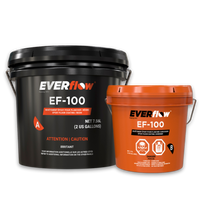
EF-MASTERFLOW is the metallic base. It is a two component, 100% solids, water-clear resin built specifically for this work: an advanced defoamer system for a pinhole-free surface, a 32 mil high build so the three dimensional depth has room to develop, and 7,200 psi strength once cured. Its stated coverage is 160 square feet per kit, which is deliberately thicker than a standard garage build.
Color comes from metallic pigment pods, 160 grams each, in over 50 colors. On a standard 3-gallon kit, one pod tints one kit. Metallic pours are a different mix, so confirm the ratio with us for your build rather than assuming. Browse the full pigment range and the metallic systems line.
The working window on a metallic pour is short, roughly 30 to 40 minutes. That is not a problem, it is a planning constraint. Have your team, your tools, and your layout sorted before you mix.
UV stability matters more here than anywhere else
Showrooms have glass. Storefronts have glass. A floor that sits in daylight all day will amber and go yellow if the resin is not UV stable, and it happens unevenly, so you get a sunlit patch that no longer matches the rest of the room. EF-MASTERFLOW is UV stable and made not to yellow or fade.
For the wear surface, a polyaspartic topcoat adds UV stability and abrasion resistance over the metallic layer. On a retail floor taking cart wheels, heels, and daily mopping, the topcoat is what you are actually walking on, and it is the layer you eventually refresh instead of redoing the art underneath.
Closing the space for as little time as possible
Retail downtime is revenue. Polyaspartic chemistry is what compresses the schedule: EF-290 recoats in 2 to 4 hours and takes foot traffic in 3 to 6. A realistic sequence for a small retail floor is prep and base on a Friday after close, topcoat Saturday, open Monday.
Larger spaces get sectioned and rotated so part of the floor stays in service. Plan the section joints where a transition will not be noticed, such as under a fixture line, rather than mid-aisle.
The maintenance argument over tile
Grout is the part of a tile floor that ages badly. It stains, it holds dirt, and cleaning it is labor. A seamless coated floor has nowhere for that to happen. Day to day it is a dust mop and a damp mop with a neutral cleaner. Nothing gets ground into a joint because there is no joint.
Sizing a metallic floor
Metallic pours use more material than a standard solid color build because the film is intentionally thicker. Do not size a metallic floor off garage kit math. Work from EF-MASTERFLOW's own coverage, and when in doubt order the extra kit. A pour that runs dry in the middle of a showroom floor leaves a visible line you cannot blend out later.
Start with the coverage guide, then call us with the actual footage before you order a metallic job.
Common questions
Can I see real metallic floors before I commit?
Yes. The project gallery has finished metallic work in retail, salon, and residential spaces, including full room shots rather than just close-ups of the resin.
Can we match a brand color?
Metallic is not a flat brand color system. It moves and varies by design, so an exact corporate color match is not what it does well. If you need a precise flat color, a solid tone pigment is the right tool and a metallic is not. Send us the target and we will tell you honestly which way to go.
What happens if someone damages it in five years?
Coated floors repair better than tile. A worn or scratched wear layer can be abraded and recoated without touching the metallic layer underneath. Physical damage down into the base is a patch and blend, which is more work, but it does not mean pulling up the whole floor.
Talk to a coatings expert
Send us the square footage, how much daylight the space gets, and how long you can close. We will spec the system, the pigment, and the topcoat, and build the material list. Call (800) 413-1427 or use the contact page.