
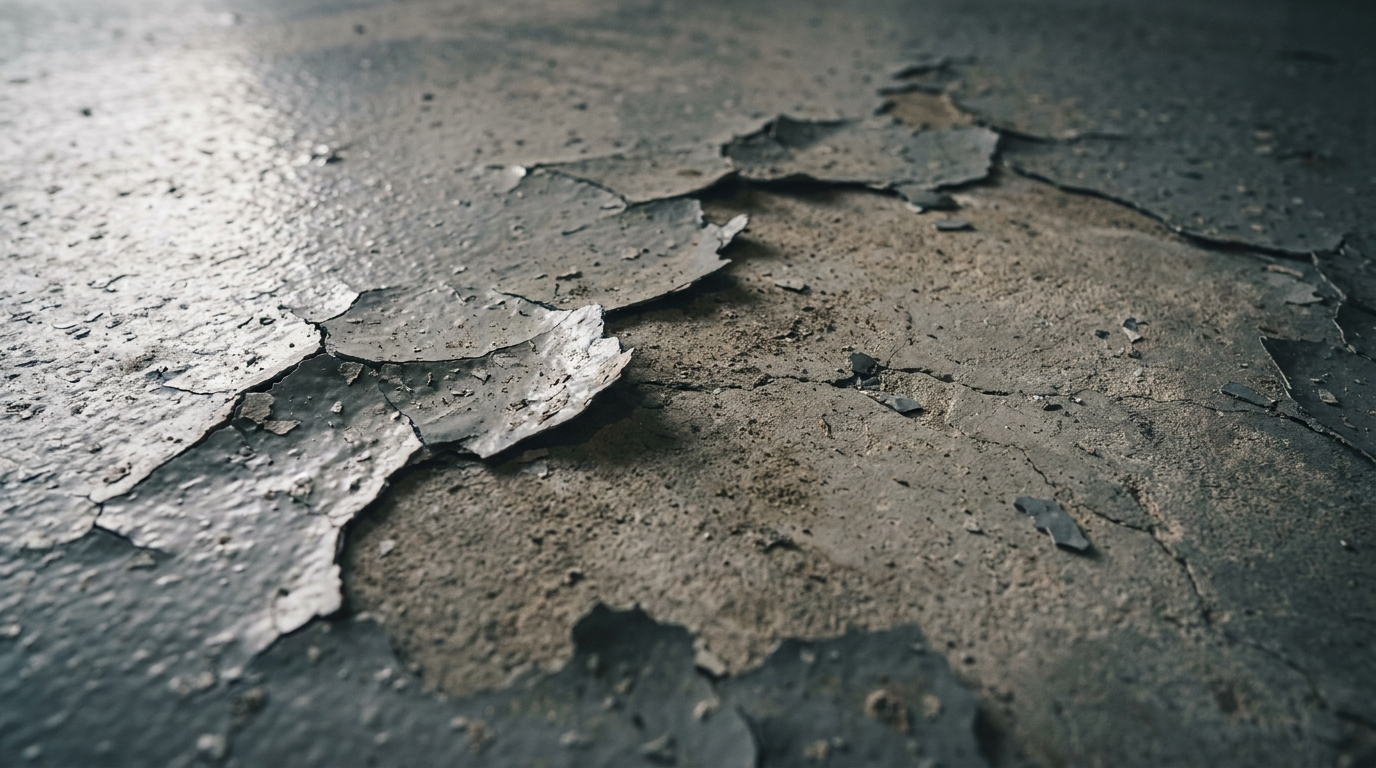
Few things are more frustrating than watching a fresh epoxy floor lift, flake, or peel away weeks after you finished it. The good news: epoxy doesn't peel randomly. It peels for a short list of predictable reasons, and almost every one of them traces back to a single root cause: the epoxy never truly bonded to the concrete in the first place. Here are the seven culprits, and how to make sure your floor stays down for good.
1. The concrete was never properly profiled
This is the number-one cause, full stop. Epoxy bonds mechanically. It needs a slightly rough, open-pore surface to grip. A smooth, troweled, or power-floated slab is like painting glass: it looks fine for a while, then sheets right off. Concrete must be ground or shot-blasted to a CSP-2 to CSP-3 profile (roughly the texture of medium sandpaper). Acid etching alone often isn't aggressive enough on dense concrete.
Prevent it: Follow our guide on preparing concrete for epoxy. If water beads on the surface instead of soaking in, it isn't ready.
2. Moisture pushing up through the slab
Concrete sitting on grade is constantly wicking water vapor up from the soil beneath it. That hydrostatic pressure pushes against the underside of your coating and breaks the bond. You'll see bubbling, then peeling, often in patches. This is the silent killer of garage and basement floors.
Prevent it: Do a calcium chloride or RH probe test first. If the slab reads high, prime it with a moisture vapor barrier before you coat. Here's why every slab needs one.
3. Contamination in the concrete
Oil, grease, tire marks, silicone, and old sealers all block adhesion. Garage floors are especially bad. Years of engine drips soak deep into the pores. Epoxy applied over contamination will "fisheye" as it goes down and peel later.
Prevent it: Degrease thoroughly, then grind. Grinding is what actually removes the contaminated top layer and any previous sealer.
4. It was applied over a sealed or previously coated floor
Many slabs already carry a cure-and-seal or a failing old coating. New epoxy can only bond as well as whatever is underneath it. Bond to a loose sealer and you inherit its failure.
Prevent it: Mechanically remove existing coatings and sealers down to raw, profiled concrete.
5. Temperature and humidity were out of range
Epoxy is a chemical reaction, and cold concrete slows or stalls it. Coat a 45°F slab and the epoxy may never fully cross-link, leaving a soft, weakly bonded film. Applying in high humidity or with dew forming can cause "amine blush" that ruins adhesion of the next coat.
Prevent it: Work within the product's temperature window (generally 55-85°F and rising). When it's cold, a fast-cure epoxy gives you more margin.
6. The recoat window was missed
Between coats, epoxy has a window where the next layer chemically bonds to it. Wait too long and the surface cures too hard, and now the topcoat only bonds mechanically and can delaminate. Miss it and you may need to scuff-sand before recoating.
Prevent it: Follow the recoat times on your product's data sheet. Plan your day so you're not recoating a floor that cured overnight without a scuff.
7. Bad mix ratio or expired product
Epoxy is two parts measured precisely. Eyeball the ratio, mix it lazily, or use product that's been sitting for years, and it won't cure to full hardness, and a soft floor is a peeling floor.
Prevent it: Measure by the manufacturer's ratio, mix the full recommended time (scraping the sides and bottom), and use fresh product.
Can you fix a peeling epoxy floor?
Sometimes. If only a small, isolated area lifted and the rest is rock-solid, you can grind out the failed section, feather the edges, and patch. But if the floor is peeling in multiple places, the bond failed system-wide, and the honest fix is to grind it all off and start over with proper prep. It's painful, but a patched-over adhesion failure just fails again.
Frequently asked questions
What is the number one reason epoxy floors peel?
Inadequate surface preparation. Epoxy bonds mechanically to a profiled, open-pore surface. Applied over smooth, sealed, or contaminated concrete, it can't grip and eventually peels.
How do I know if my concrete has a moisture problem?
Tape a plastic sheet to the slab overnight (or run a calcium chloride / RH probe test). Condensation or a darkened slab underneath means moisture is present, and you should prime with a moisture vapor barrier before coating.
Can I fix a peeling epoxy floor without redoing the whole thing?
Only if the failure is small and isolated. Grind out the bad area, feather the edges, and patch. Widespread peeling means the bond failed everywhere, and the floor should be removed and redone with proper prep.
The theme running through all seven causes is the same: a floor is only as good as its bond to the slab. Prep like a pro, test for moisture, respect the product's window, and epoxy will outlast the concrete under it. Browse our full coating system when you're ready to do it right.
Conocimiento que construye mejores pisos.
Explora la biblioteca completa de guías, tutoriales e información de producto para contratistas.