
Search this question and you will find a dozen articles treating epoxy, polyaspartic and polyurea as rivals, each one ending with "so pick the one that suits you." That framing sends a lot of people down the wrong path.
On a professional floor, these coatings are rarely competitors. They are layers. Most durable systems use two or three of them, each doing the job it is best at. Once you know what each one is for, the choice mostly makes itself.
The short answer
- Epoxy is the foundation. It bonds to prepared concrete, builds thickness and delivers strength. It is not UV stable.
- Aliphatic polyurea is a UV-stable coating that bonds to prepared concrete and recoats in a few hours.
- Polyaspartic is a UV-stable clear topcoat. It goes over a base, never on bare concrete.
- Polyurethane is a satin, slip-resistant finish coat over a cured epoxy floor.
Epoxy: the foundation
A 100% solids epoxy has no solvent to evaporate, so the film you roll out is the film you keep. That makes it the right material for building a thick, strong base that grips the slab.
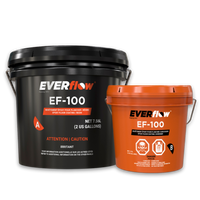
The numbers back that up. EF-100 reaches 6,200 psi compressive strength. LTX-100 reaches 18,400 psi, with 290 psi adhesion to prepared concrete, which is at or above the pull-off strength of sound concrete itself. On a correctly profiled slab, a bond failure happens in the concrete before it happens at the coating line.
Epoxy also gives you a workable pour. EF-100 has 30 to 40 minutes of working time at 70°F, and both products are low VOC, under 50 g/L for EF-100 and under 30 g/L for LTX-100.
The weakness is sunlight. Every epoxy ambers under prolonged UV exposure. Indoors and away from windows that may never matter. On a sunlit floor or anything outdoors, epoxy needs a UV-stable coating on top of it.
Polyurea: the misconception worth clearing up
A lot of comparisons state flatly that polyurea is not UV stable. That is only half true, and the half that is wrong matters.
Polyurea comes in two chemistries. Aromatic polyureas discolor in sunlight. Aliphatic polyureas are built not to. EF-285 is an aliphatic polyurea, so it resists yellowing and chalking in sun-exposed areas.
What makes an aliphatic polyurea useful is that, unlike a clear polyaspartic topcoat, it bonds directly to diamond-ground concrete. EF-285 works as a UV-stable primer and base coat in one. It is 85% solids, recoats in 2 to 4 hours at 68°F, takes foot traffic in 4 to 8 hours and stays under 50 g/L VOC. As with any coating on concrete, the slab still needs to pass a moisture test, and needs a moisture barrier if it fails.
Polyaspartic: the clear topcoat
Polyaspartic is technically part of the aliphatic polyurea family, but the clear polyaspartic topcoats play a different role. They are the protective clear layer on top of a floor system.
They are crystal clear, high gloss and UV stable, so they will not yellow or chalk. They are tough on abrasion too. EF-275 tests at 0.03 g loss on the Taber abrasion test. And they cure fast: EF-275 recoats in 2 to 4 hours and takes foot traffic in 4 to 8 hours at 68°F.
Two rules keep polyaspartic out of trouble:
- It does not go on bare concrete. Apply it over a prepared base coat or a flake broadcast.
- It is clear only. Build the color into the layer underneath, with a pigmented base or a flake broadcast, then seal it.
One thing to expect: rubber tires can mark a polyaspartic floor through plasticizer migration, and quick stops or starts can leave rubber marks. That is normal for clear coatings, and mats under parked vehicles solve it.
Polyurethane: the satin, slip-resistant finish
If a high-gloss floor is the wrong look or too slick for the space, a polyurethane finish coat is the answer. EF-301 is a three-component aliphatic polyurethane with a satin finish of about 35 GU at 60°, low enough to hide scuffs and traffic marks. It is formulated with aluminum oxide for about 0.80 DCOF wet traction, which makes it a strong choice for ramps, entries, kitchens and other wet-prone areas.
It goes over a cured epoxy or urethane floor, not on bare concrete, and covers about 350 to 450 sq ft per gallon at 5 mils wet.
Side by side
| Coating | Role | Bonds to bare prepared concrete | UV stable | Recoat at 68°F | Finish |
|---|---|---|---|---|---|
| Epoxy (EF-100, LTX-100) | Base coat | Yes | No | 18 to 24 hr (EF-100) | High gloss |
| Aliphatic polyurea (EF-285) | UV-stable primer and base | Yes | Yes | 2 to 4 hr | Clear |
| Polyaspartic (EF-275, EF-290) | Clear topcoat | No | Yes | 2 to 4 hr | Clear, high gloss |
| Polyurethane (EF-301) | Finish coat | No | Yes | n/a | Satin |
How they stack in real floor systems
Standard garage flake floor
Prepared concrete, an epoxy base such as EF-100 or LTX-100, a full flake broadcast, then a polyaspartic clear topcoat like EF-275. The epoxy supplies the bond and body, the flake supplies the color and texture, and the polyaspartic protects it all from wear and sunlight. The full process is in the broadcast flake system guide.
Sunlit or outdoor floor
Keep UV-stable chemistry on the surface. An aliphatic polyurea base with a polyaspartic topcoat holds its color where a bare epoxy would amber.
Wet-prone commercial areas
An epoxy base with a satin polyurethane finish like EF-301 on top, for chemical resistance, hidden scuffs and 0.80 DCOF wet traction.
Metallic floor
A primed base, a metallic layer of EF-Masterflow with metallic pigment, and a UV-stable clear topcoat wherever the floor sees direct sun. See how to install a metallic epoxy floor.
So which should you choose?
Ask four questions and the system builds itself:
- Does the floor see sunlight? Then the top layer needs to be UV stable: polyaspartic, aliphatic polyurea or polyurethane.
- Does it need to take a beating? Build the base in 100% solids epoxy for strength and thickness.
- How fast does it need to reopen? The polyaspartic and polyurea coatings recoat in hours, not a day.
- Gloss or grip? Polyaspartic for a clear, high-gloss finish. Polyurethane for satin and slip resistance.
For a deeper look at the two most common layers, read polyaspartic vs epoxy. And before any of these go down, make sure the slab passes a moisture test.
Frequently asked questions
Is polyurea UV stable?
It depends on the chemistry. Aromatic polyureas discolor in sunlight. Aliphatic polyureas, like EF-285, are UV stable and resist yellowing and chalking.
Can polyaspartic go directly on concrete?
Clear polyaspartic topcoats like EF-275 and EF-290 are not designed for bare concrete. They go over a prepared base coat or a flake broadcast. If you want a UV-stable coating that bonds to prepared concrete, use an aliphatic polyurea.
Is polyaspartic better than epoxy?
They do different jobs. Epoxy is the strong, thick foundation that bonds to concrete, but it ambers under UV. Polyaspartic is a UV-stable clear topcoat. Most durable floors use both, with epoxy underneath and polyaspartic on top.
Which floor coating cures fastest?
At 68°F, polyaspartic topcoats and aliphatic polyurea recoat in 2 to 4 hours and take foot traffic in 3 to 8 hours. A standard epoxy like EF-100 needs 18 to 24 hours before it can be recoated.
CONTINUE LENDO
Mais guias dos profissionais da Latux
Conhecimento que constrói pisos melhores.
Explore a biblioteca completa de guias, tutoriais e informações de produto para contratantes.