
How Much Epoxy Do I Need? Coverage Guide for Garage and Concrete Floors
Figuring out how much epoxy to buy comes down to three things: the size of your floor, how thick you plan to pour, and whether you are running a full system with a primer and a topcoat. This guide walks through the math the way a floor contractor does it, using coverage figures straight from Latux Technical Data Sheets.
The short answer
Measure your floor in square feet, then match it to the coverage of the system you want. As a starting point:
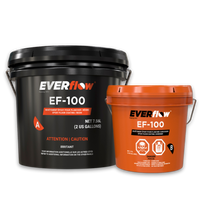
- A solid-color garage floor covers 150 to 200 square feet per 3-gallon EF-100 kit in one base coat.
- A metallic floor, poured thicker for depth, covers about 160 square feet per 4-gallon kit, and it still needs a base coat under it and a topcoat over it.
- A full broadcast flake floor uses that same 150 to 200 square feet per 3-gallon base kit, plus about 25 lb of 1/4 inch flake per 125 to 175 square feet broadcast to refusal, which is Torginol's full coverage rate of 5 to 7 square feet per pound.
Always round up and add a cushion for waste. Running short in the middle of a pour is the one mistake you cannot fix cleanly.
Step 1: Measure your floor
Multiply length by width to get square feet. For odd shapes, break the floor into rectangles and add them together. Here are common garage sizes to size against:
| Garage | Typical dimensions | Square feet |
|---|---|---|
| 1 car | 12 x 20 ft | about 240 |
| 2 car | 20 x 20 to 24 x 24 ft | about 400 to 576 |
| 3 car | 30 x 22 ft | about 660 |
Measure your own slab. Builder "2-car" sizes vary, and a 40 square-foot difference can be a whole extra kit.
Step 2: Coverage and mils, explained
Epoxy coverage is driven by thickness, measured in mils. One mil is one thousandth of an inch. A 100% solids epoxy covers about 1,604 square feet per gallon at 1 mil. Floors go on much thicker than that, so the real coverage per gallon is far smaller.
The formula contractors use:
Coverage per kit (sq ft) = kit gallons x 1,604 divided by mils
Pour thicker and each kit covers less floor. Pour thinner and it covers more, but you give up depth and durability. Because that trade-off is where most estimates go wrong, Latux publishes coverage as square feet per kit rather than as a target film thickness. Order from the square footage.
Coverage by Latux system
These figures come from the product Technical Data Sheets at their standard build thickness.
| System | Kit | Standard build | Coverage per kit |
|---|---|---|---|
| Solid color / garage (EF-100, EF-150, EF-155) | 3 gal | One base coat | 150 to 200 sq ft |
| Metallic (EF-Masterflow) | 4 gal | 40 mils | about 160 sq ft |
| Full broadcast flake floor (EF-100 base plus floor flakes) | 3 gal + 25 lb | Base coat, flakes to refusal | 150 to 200 sq ft of base epoxy; 25 lb of 1/4 in flake covers about 125 to 175 sq ft (40 lb: 200 to 280 sq ft) |
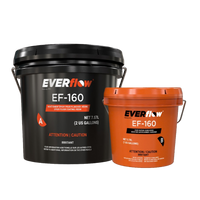
| Moisture vapor barrier (EF-160) | 3 gal | about 18 mils | about 264 sq ft |
| Polyaspartic topcoat (EF-290) | 2 gal | 8 mils | about 400 sq ft |
| Polyurethane topcoat (EF-301) | 1 gal | 5 mils | about 400 sq ft |
The same EF-100 kit covers a different area depending on the job it is doing. Spread thin as a primer, one kit stretches to 480 to 600 square feet. As the base coat that carries the floor, plan on 150 to 200 square feet per kit, and lean toward 150 when the slab is freshly ground or porous.
Step 3: Worked garage examples
Base coat only, before primer and topcoat:
| Floor | EF-100 base coat | Metallic at 40 mils |
|---|---|---|
| 1 car, 200 to 250 sq ft | 2 kits | 2 kits |
| 2 car, 400 to 500 sq ft | 3 to 4 kits | 4 kits |
| 2.5 car, 500 to 600 sq ft | 3 to 4 kits | 4 kits |
| 3 car, 600 to 750 sq ft | 4 to 5 kits | 5 kits |
The base coat column assumes one full base coat at 150 to 200 sq ft per 3-gallon kit, sized to the top of each area range and rounded up to the next whole kit. Where two numbers are shown, the lower count is the thin end of the build and the higher count covers a thirsty slab. A primer pass or a second base coat is extra.
These are base-coat counts. A finished floor usually adds a primer or moisture barrier underneath and a topcoat on top, each with its own coverage.
Shop by garage size
We grouped what each floor needs, base kits, pigment pods, topcoats, flakes, and tools, into one page per garage size: 1-car garage epoxy kit, 2-car garage epoxy kit, and 3-car garage epoxy kit.
Add for waste and rough concrete
Keep a 10% waste cushion on a smooth, sound slab, and 15 to 20% on rough or freshly ground concrete. A porous or heavily profiled surface drinks up extra material on the first coat, so add it to the base or primer, not the topcoat.
Do not forget primer and topcoat
A durable floor is a system, not a single bucket:
- Primer or moisture vapor barrier on bare or damp concrete, for adhesion and moisture control.
- Base coat in your color or metallic finish.
- Topcoat, polyaspartic or polyurethane, for UV stability, gloss, and abrasion resistance.
Size each layer on its own coverage. They do not share the same number.
Get an exact takeoff
The table method gets you close. For a precise kit-by-kit list that accounts for film build, surface profile, color, and topcoat, Latux Pro members can log in and use the interactive Coverage Calculator in the dashboard.
Shop epoxy floor coatings Log in to your Pro account
Frequently asked questions
How much epoxy do I need for a 2-car garage?
A typical 2-car garage runs 400 to 500 square feet. For a solid-color floor, plan on 3 to 4 EF-100 base kits plus a topcoat, at 150 to 200 square feet per 3-gallon kit. For a metallic floor at 40 mils, plan on 4 EF-Masterflow kits. Measure your slab and round up.
How many square feet does a gallon of epoxy cover?
A 100% solids epoxy covers about 1,604 square feet per gallon at 1 mil. Real floors go on much thicker, so a gallon covers far less. On a garage floor, a 3-gallon EF-100 kit covers 150 to 200 square feet in one base coat, which works out to roughly 50 to 67 square feet per gallon.
How thick should an epoxy floor be?
Thickness follows from how much product you spread over the area, which is why Latux publishes coverage per kit instead of a target film build. For a garage base coat, a 3-gallon EF-100 kit covers 150 to 200 square feet, and that square footage is the number to order from. Metallic floors are poured much thicker for depth and a poured-glass look, around 32 to 50 mils, so each kit covers far less area.
Do I need a primer or moisture barrier?
On bare or high-moisture concrete, yes. A primer or moisture vapor barrier improves adhesion and blocks slab moisture that can lift a coating later. Size it as its own layer with its own coverage.
Does rough concrete use more material?
Yes. Freshly ground or porous concrete absorbs more on the first coat. Add material to the base or primer on a rough profile, and keep a 10% waste cushion, 15 to 20% on rough slabs.
Why does a metallic floor cover less than a solid color?
Metallic is poured thicker and it is a layered system. A 4-gallon EF-Masterflow kit covers about 160 square feet, which is about 40 square feet per gallon, against 50 to 67 square feet per gallon for an EF-100 garage base coat. On top of that, a metallic floor needs a solid base coat under it and a clear topcoat over it, so the job uses more material overall.