
Epoxy vs Polyaspartic: Which Floor Coating Do You Need?
This gets framed as a fight between two products. It usually is not. On most real floors, epoxy and polyaspartic are not competitors, they are two layers of the same system doing two different jobs. Epoxy bonds to the concrete and builds the film. Polyaspartic goes over the top and takes the wear, the sunlight, and the schedule pressure.
The useful question is not which one is better. It is which one goes where, and whether your particular floor needs both.
What epoxy is good at
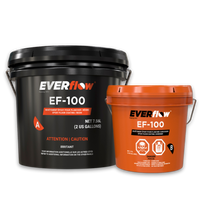
Adhesion and build. A 100% solids epoxy like EF-100 keys into a properly ground slab and lays down a true 12 to 24 mil film in one pass, because nothing evaporates out of the bucket. Everything you mix becomes floor. Cured, it reaches 6,200 psi compressive and 5,500 psi tensile with a Taber abrasion loss of 0.1 g (CS-17, ASTM D4060), and it carries 0 flame spread in fire testing.
That thickness is what fills minor slab texture, buries a flake broadcast, and gives a metallic pour room to develop depth. Epoxy is the structural layer. See the standard and fast-cure epoxy line.
Its weakness is sunlight. Epoxy ambers under UV. On a floor that gets direct daylight, an unprotected epoxy surface will yellow, and it yellows unevenly, so the sunlit strip near the door stops matching the rest of the room.
What polyaspartic is good at
Wear resistance, UV stability, and speed. EF-290 is a 90 percent solids clear that wears at 0.03 g Taber loss. That is roughly a third of the abrasion loss of the epoxy base, which is exactly why it belongs on top: it is the layer designed to be sacrificed and eventually recoated, protecting the color you paid for underneath.
It also does not amber, and it cures fast enough to change the economics of a job. EF-290 recoats in 2 to 4 hours, takes foot traffic in 3 to 6, and carries vehicle traffic in about a day. That is how a commercial space closes Friday and opens Monday.
Its weakness is the flip side of its strength. Fast cure means a short working window, and a short working window is unforgiving if you have never rolled one before.
Head to head
| 100% Solids Epoxy | Polyaspartic | |
|---|---|---|
| Job in the system | Base coat, bonds to concrete | Wear course, goes on top |
| Film build per coat | High, 12 to 24 mils | Lower, built for wear not thickness |
| Abrasion (Taber CS-17) | 0.1 g loss | 0.03 g loss |
| UV stability | Ambers in direct sun | Stable, does not yellow |
| Cure speed | Slower, standard or fast-cure options | Fast, hours not days |
| Working window | Forgiving | Short, plan before you mix |
| Best at | Adhesion, build, filling, flake and metallic beds | Wear, sunlight, fast reopening |
So which do you need?
Both, on most floors
Garage, showroom, warehouse, shop, retail. Epoxy base for the bond and the build, polyaspartic topcoat for wear and UV. This is the default for a reason, and it is what we spec unless something about the job says otherwise.
Epoxy on its own
Reasonable where there is no direct sunlight, appearance is secondary, and budget is tight. A storage room, a utility space, a basement with no windows. You are trading the wear layer and the UV protection for a lower material cost, and you should expect to recoat sooner.
Polyaspartic direct to concrete
It can be done, and it is fast, but you give up the film build that fills slab texture and the thick bed that a flake broadcast or metallic pour needs. It works best on a sound, smooth slab where speed is the whole point. Talk to us before going this route, because prep quality carries more weight when there is no epoxy base underneath.
The honest DIY warning
If this is your first floor, the fast-cure products are not where to start learning. A short working window means a mistake cannot be fixed by slowing down and thinking about it. Plenty of first-time installers do a standard-cure epoxy base successfully, then get surprised by how quickly the topcoat sets.
Read the tutorials first, and consider the LTX Masterclass if you want to learn on someone else's slab instead of your own. Every current data sheet with real working times is on the technical data sheets page.
What about the other layers?
Two more that get missed. If the slab is on grade and reads damp, a moisture vapor barrier goes down before anything else, or slab moisture will lift the whole system later. And on porous or questionable concrete, a primer improves the bond of what follows.
Common questions
Is polyaspartic just a better epoxy?
No. It is a different chemistry with different strengths. It wears better and holds color in sunlight, but it does not build film the way a 100% solids epoxy does, and film build is what a flake or metallic floor is standing on.
Can I put polyaspartic over an existing epoxy floor?
Usually yes, and it is one of the better ways to extend a floor that is dull but sound. It needs mechanical abrasion first so the topcoat has something to grip. If the existing coating is lifting anywhere, that has to come off instead.
Which one for a garage with the door open all day?
Both, and do not skip the topcoat. That is the exact case where an unprotected epoxy floor ambers in a visible band near the door, and where hot tires do the most damage.
Talk to a coatings expert
Tell us the space, the square footage, how much sunlight it gets, and how long you can keep it closed. We will tell you which layers you actually need and which you can skip. Call (800) 413-1427 or use the contact page. Ready to shop? Start with epoxy coatings and kits or polyaspartic topcoats.