
Metallic vs Flake vs Solid Color Epoxy: Which Floor System Is Right for You
Three floors can start from the same epoxy base and end up completely different. One is a clean, uniform color. One is a textured field of multicolor chips. One is a glossy, marbled surface with depth you can almost see into.
Choosing between solid color, flake and metallic is not really about which looks best in a photo. It is about how the floor will be used, what it has to hide, how slippery it can afford to be, and how much installation risk you want to take on. Here is how the three compare.
How each system is built
Solid color
The simplest system. Pigment goes into the epoxy base coat, which is rolled out as a uniform color and then protected with a topcoat. With a tintable base like LTX-100, pigment goes into Part A only and is fully dispersed before Part B is added. Solid tone liquid pigment pods are measured for the job.
Flake
An epoxy bond coat goes down, and vinyl flake is broadcast into it while it is wet, usually to full refusal so no base shows through. Once the base cures, the loose flake is scraped off and the floor is sealed with a clear topcoat. LTX-100 works as the bond coat at about 16 mils. The full step-by-step is in the broadcast flake system guide, and flake comes in 25 pound and 40 pound boxes.
Metallic
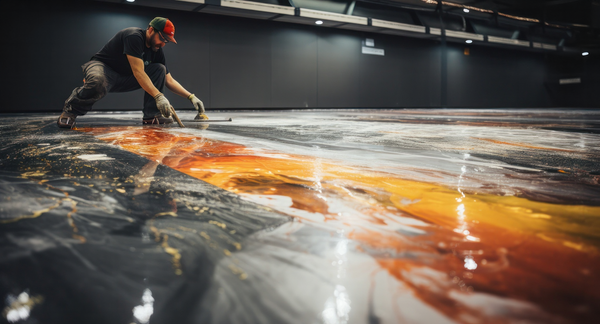
The most involved system, and a layered one. A primed base goes down first. Then a decorative metallic coat is poured, with metallic pigment dispersed through it, and worked while wet to create movement and depth. A UV-stable clear topcoat finishes it wherever the floor sees sun. EF-Masterflow is built specifically for that metallic layer, with defoamers and surface additives for a pinhole-free pour and a 94.7 GU gloss. It takes one 160 gram pod of metallic pigment per 4-gallon kit, or up to 210 grams for a denser, more opaque effect.
Look and feel
- Solid color reads clean, uniform and utilitarian. Great for shops, utility spaces and anywhere you want a neutral, easy-to-clean surface.
- Flake reads like granite or terrazzo, with texture and multicolor depth. The most common choice for garages.
- Metallic reads like marble, liquid metal or a pearlescent swirl, with real three-dimensional depth. No two floors come out the same.
Slip resistance
This is where the systems differ most in daily use.
A metallic floor is a smooth, high-gloss pour, which makes it the slickest of the three when wet. A solid color floor is also smooth. A flake floor has texture from the broadcast chips, which gives more grip underfoot.
Any of the three can be made safer. A satin polyurethane finish coat like EF-301, formulated with aluminum oxide, provides about 0.80 DCOF wet traction. It is a strong choice for entries, ramps and any space that sees water.
Hiding dirt, wear and slab flaws
Flake wins this clearly. The multicolor chips disguise dust, tire marks, scuffs and small imperfections in the slab. That forgiveness is a big part of why flake dominates garages and high-traffic spaces.
Solid color and metallic floors are both smooth and glossy, so they show scratches and dust more readily. A metallic floor's movement can mask some variation in the pour itself, but its high-gloss surface shows everyday wear.
Difficulty to install
- Solid color is the most straightforward. Mix, roll to an even film, topcoat.
- Flake is forgiving. The broadcast hides lap marks and small application flaws that would show on a solid color.
- Metallic is the most technique-dependent. The movement you create while the coat is wet becomes the finished look, and the glossy surface shows mistakes. It rewards practice, and first-timers should read how to install a metallic epoxy floor before starting.
Material use
Metallic uses the most material. The metallic coat is a thick pour, and that thickness is what gives it depth. EF-Masterflow covers roughly 110 to 200 sq ft per 4-gallon kit depending on build, on top of the base and topcoat. Flake and solid color use thinner films, so a kit goes further. For planning the real cost of your space, see epoxy garage floor cost.
Which topcoat goes on each system
The base system decides the look. The topcoat decides how well that look survives traffic, chemicals and light, so plan it at the same time.
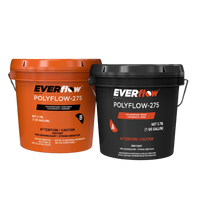
- Solid color: a clear polyaspartic like EF-275 for a high-gloss, UV-stable finish, or EF-301 for a satin, slip-resistant one. Polyaspartic is clear only, so the color always lives in the base coat underneath it.
- Flake: a clear polyaspartic is the standard choice. EF-275 covers about 267 sq ft at 12 mils over a vinyl flake broadcast, enough to lock the chips in and give the surface a durable, cleanable wear layer.
- Metallic: a UV-stable polyaspartic topcoat, for gloss retention and to protect the color and depth you worked to create. It matters most anywhere the floor sees direct sun.
For a full breakdown of what each topcoat does, see polyaspartic vs epoxy.
Sunlight and UV
All three systems are built on epoxy, and every epoxy ambers under prolonged UV exposure. How much that matters depends on the system.
On a flake floor, the chips and the clear topcoat carry most of the color, so a UV-stable topcoat does most of the protecting. On a solid color floor, the pigmented base is the color, so any yellowing shows directly unless a UV-stable topcoat is on top. On a metallic floor, EF-Masterflow uses cycloaliphatic chemistry that resists yellowing far better than standard epoxy, but for prolonged sun a UV-stable polyaspartic topcoat gives it full color protection.
The rule is simple: if sunlight reaches the floor, finish it with a UV-stable topcoat, whichever system you chose.
Quick comparison
| Solid color | Flake | Metallic | |
|---|---|---|---|
| Look | Uniform color | Granite or terrazzo texture | Marbled, 3D depth |
| Grip when wet | Smooth | Most grip | Slickest |
| Hides dirt and wear | Fair | Best | Shows wear |
| Installation difficulty | Easiest | Forgiving | Hardest |
| Material use | Lower | Lower | Highest |
| Best for | Shops, utility and industrial spaces | Garages and high traffic | Showrooms, retail and living spaces |
Which one should you choose?
- Garage, shop or anywhere that gets dirty: flake. It grips, hides wear and forgives installation.
- Showroom, retail floor, office or living space where the floor is the statement: metallic, with a slip-resistant finish in any area that gets wet.
- Utility, storage or industrial space where function comes first: solid color.
Whichever system you pick, all three share the same foundation: a properly prepared, moisture-tested slab. See the best epoxy for garage floors for choosing the base.
Frequently asked questions
Which is more slippery, metallic or flake epoxy?
A metallic floor is a smooth, high-gloss pour, so it is the more slippery of the two when wet. Flake adds texture underfoot. For extra grip on any system, a satin polyurethane finish like EF-301 formulated with aluminum oxide provides about 0.80 DCOF wet.
Is metallic epoxy harder to install than flake?
Yes. Flake is forgiving, since the broadcast hides lap marks and minor flaws. Metallic depends on technique, because the pigment movement you create while the coat is wet becomes the finished look, and a glossy surface shows mistakes.
How much pigment does a metallic epoxy floor need?
With EF-Masterflow, use one 160 gram pod of metallic pigment per 4-gallon kit. You can load up to 210 grams for a denser, more opaque metallic effect.
Which epoxy floor hides dirt and wear best?
Flake. The multicolor chips disguise dust, scuffs, tire marks and small slab imperfections far better than a solid color or a glossy metallic surface.
CONTINUE LENDO
Mais guias dos profissionais da Latux
Conhecimento que constrói pisos melhores.
Explore a biblioteca completa de guias, tutoriais e informações de produto para contratantes.