
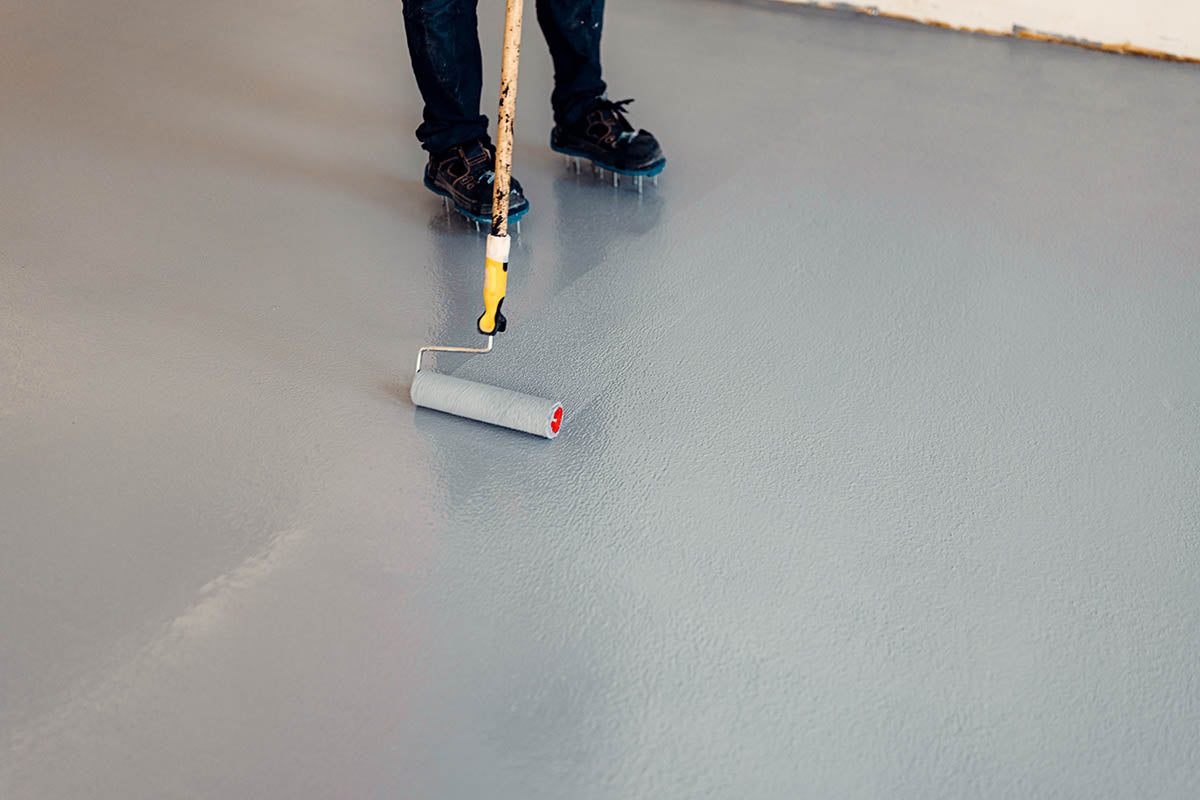
You have put in the prep work. The floor is ground, clean and ready. You apply your epoxy system, everything looks perfect, and three months later the floor is bubbling and peeling off the slab. What happened?
In most cases, the answer is moisture vapor. This invisible force is responsible for more epoxy failures than bad products, incorrect mixing or poor application combined. Understanding moisture vapor and how to control it is one of the most important skills any epoxy installer or contractor can have.
What Is Moisture Vapor?
Concrete is a porous material. Water and water vapor move through it constantly, driven by differences in temperature and humidity between the ground below the slab and the air above it. This movement is called moisture vapor transmission (MVT) or moisture vapor emission (MVE).
Even a slab that looks and feels completely dry on the surface can be emitting significant amounts of water vapor. You cannot see it, you cannot feel it, but when you seal the slab with an impermeable coating like epoxy, the moisture has nowhere to go and builds up at the coating-to-concrete interface until it breaks the bond. The result: bubbles, blisters and delamination.
How to Test for Moisture Vapor
There are two industry-standard methods for measuring moisture vapor in concrete:
Calcium Chloride Test (ASTM F1869)
This test measures the moisture vapor emission rate (MVER) from the concrete surface. Anhydrous calcium chloride is placed under a sealed dome on the floor for 60-72 hours. The weight gain of the calcium chloride, measured in pounds per 1,000 square feet per 24 hours, gives you the MVER. Most coating manufacturers require an MVER below 3 lbs/1,000 sq ft/24 hrs before applying standard epoxy.
Relative Humidity Probe (ASTM F2170)
This test measures the relative humidity inside the concrete slab at a depth of 40% of the slab thickness. An RH above 75-80% typically indicates moisture levels that require a vapor barrier before coating.
Always perform moisture testing before quoting or committing to a floor coating job. Never assume a slab is dry.
What Is a Moisture Vapor Barrier?
A moisture vapor barrier (MVB) is a specialized two-component epoxy coating applied directly to the prepared concrete slab before any decorative or functional floor coating. Its purpose is to penetrate the surface and block moisture vapor from migrating upward through the slab.
Unlike standard floor coatings, a good MVB is formulated to tolerate higher moisture levels in the substrate. It acts as a bridge between the wet slab and the dry floor coating above it.
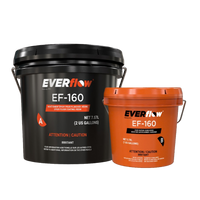
Everflow EF-160 Moisture Vapor Barrier
The Everflow EF-160 is Latux's recommended MVB for residential and commercial applications. It is a 100% solids, two-component epoxy designed specifically for controlling moisture vapor emissions on new or deteriorated concrete floors.
Key specifications:
- 100% solids formula: no shrinkage, maximum film build
- Self-leveling at standard application thickness
- Fast cure: ready for topcoat in 18-24 hours
- Available in 3-gallon kits
- Compatible with all Everflow floor coating systems
Apply EF-160 at 264 sq ft per 3-gallon kit, which works out to 18 mils. That 18 mil film is the thickness the ASTM F3010 vapor permeance test results are stated at, so do not stretch the kit thinner to cover more floor. Allow to fully cure before applying any subsequent coatings.
When Is a Moisture Vapor Barrier Required?
Any of the following conditions should trigger MVB application:
- MVER above 3 lbs/1,000 sq ft/24 hrs (calcium chloride test)
- Relative humidity above 75% (RH probe test)
- Slab-on-grade construction with no sub-slab vapor barrier
- Below-grade applications (basement floors)
- Any floor that has previously experienced moisture-related failures
- Geographic areas with high water tables or frequent flooding
When in doubt, apply the MVB. The cost of a moisture vapor barrier is a fraction of the cost of a failed floor and a warranty callback.
The Bottom Line
A moisture vapor barrier is a performance safeguard, not an upsell. Including MVB testing and application in your standard process protects your client's investment and protects your reputation.
Shop the Everflow EF-160 MVB and our full range of floor coating products at Latux, or call (800) 413-1427 for technical guidance on your specific project.
KEEP READING
More guides from the Latux pros
Knowledge that builds better floors.
Browse the full library of contractor guides, how-tos, and product insights.