
Basement Floor Epoxy Coating
A basement slab is the one floor in the house with wet ground on the other side of it. Moisture moves up through concrete as vapor, and if you seal a damp slab with the wrong product, the coating lifts in sheets a year later. That single fact drives every other decision down here, so settle it before you pick a color.
Test the slab before you buy anything
Tape a two foot square of clear plastic sheeting flat to the bare concrete, seal all four edges, and leave it 24 to 48 hours. Condensation under the plastic, or a dark patch on the slab when you peel it up, means the concrete is passing vapor. That is not a reason to skip coating. It means the system starts with a barrier instead of a color coat.
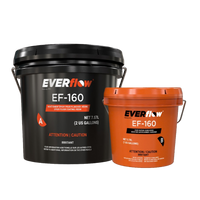
Where the slab reads damp, EF-160 moisture vapor barrier goes down first. It is a 100% solids two-part epoxy primer that controls vapor emissions on new and aged concrete, and on a slab-on-grade basement it is the difference between a floor that holds and a floor that delaminates. The full moisture vapor barrier line is here.
Choosing a system for a lived-in basement
Basements are enclosed, often finished, and usually attached to the rest of the house by an open stairwell. Odor matters more here than in a garage.
- Occupied homes and finished basements: a water-based system is the low-odor route. It is the practical choice when people are living upstairs during the install.
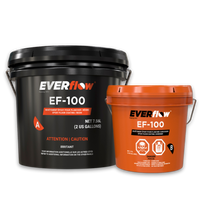
- Maximum durability: EF-100 is the 100% solids workhorse, 6,200 psi compressive and 5,500 psi tensile with a Taber abrasion loss of 0.1 g (CS-17, ASTM D4060). Because it is 100% solids, nothing evaporates out of the bucket. Everything you mix becomes floor in one pass.
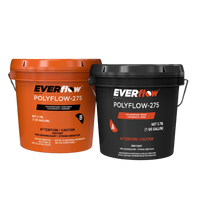
- Wear layer: a polyaspartic topcoat such as EF-275 seals the color coat and takes the daily abrasion. Browse the polyaspartic and polyurethane topcoats.
Why flake belongs on a basement floor
A basement collects dust, and a solid gloss floor shows every speck of it. A broadcast flake finish hides that, and the texture gives you grip on a surface that can pick up condensation in humid months. Flake also disguises the patch lines and trowel marks that older basement slabs are full of.
Flakes come in 25 lb and 40 lb boxes. A 25 lb box handles a light to full broadcast on a typical basement, and the larger box covers big open footage. See the flake and quartz blends, or the complete flake and quartz systems.
Prep when you cannot get a big machine down the stairs
This is the practical problem nobody mentions. A walk-behind planetary grinder does not go down a residential stairwell easily, and a basement is exactly where you least want airborne silica.
For most basements the answer is a hand grinder with the right tooling and a vacuum attached at the head. A Metabo hand grinder with diamond cup wheels handles edges, corners, and full floors at residential footage, and a dust extractor keeps the dust out of the air handler. Aim for an open, ground profile around ICRI CSP-2 so the coating keys into the concrete rather than sitting on a sealed surface.
Whatever you use, vacuum the slab properly before the first pour. Dust left on the concrete is a bond breaker.
How much material a basement takes
One 3-gallon EF-100 kit covers 150 to 200 square feet as a base coat. Primer and topcoat layers cover differently, so work each layer out with the coverage guide. One 160 gram pigment pod tints one 3-gallon kit, so match pods to base kits.
Measure the slab rather than trusting the floor plan, then run the numbers through the epoxy coverage guide. Basements are rarely simple rectangles, and the alcoves add up.
Common questions
Can I coat a basement floor that has had water on it before?
Often yes, but find out why it flooded first. A coating is not a waterproofing repair, and it will not hold back standing water pushing up through a crack. Fix the source, repair the cracks with a crack filler, run the plastic sheet test, then coat.
Will it be too cold down there to cure?
Slab temperature matters more than air temperature, and basement slabs run cold. Check the product data sheet for the minimum application temperature and give the slab time to come up before you pour. Every current data sheet is on the technical data sheets page.
Do I need the topcoat in a basement?
A basement sees far less UV and hot-tire contact than a garage, so the topcoat is doing abrasion and cleanability work rather than UV work. Most basement floors are better with it, especially under a flake broadcast, where the topcoat is what buries the flake edges and makes the floor smooth to walk and mop.
Talk to a coatings expert
Send us the square footage, whether the slab passed or failed the plastic sheet test, and whether the house is occupied during the install. We will spec the system and build the material list. Call (800) 413-1427 or use the contact page.