
Aircraft Hangar Floor Coatings
What actually goes wrong on a hangar floor
Tyre pickup, and it is a cure problem before it is a product problem
An aircraft or a tug comes off a 130F ramp and parks on a floor that is twenty degrees cooler. Hot rubber plasticises a coating that has not reached full cure and bonds to it, and when the aircraft moves it takes the film with it. Two things prevent it. A hard, fully cured 100% solids build coat, and the discipline to keep the tyres off until the manufacturer's full cure time has passed rather than the foot traffic time. Every hangar floor we have seen with tyre marks was opened early.
The light problem nobody specifies for
A mechanic on a creeper under a wing is working off reflected light. A dark grey floor eats it and the shop ends up running drop lights everywhere. A light coloured floor with a high gloss clear over it measurably changes how the underside of an airframe reads. EF-290 finishes at 89.5 GU. The trade off is honest: high gloss shows every scuff and every tug tyre mark, so a busy maintenance bay often wants the satin EF-301 instead and accepts a little less bounce.
Hydraulic fluid, fuel and the door line
Hydraulic fluid and fuel are the chemical load, and they collect in the same three places every time: under the jack points, at the tail, and in the strip just inside the door where rain blows in. That door strip also gets the only real UV exposure in the building. A clear epoxy left uncoated will amber in that stripe and it will look like a stain that nobody can clean. Our own MONEY COAT page says it plainly: a clear epoxy can amber under prolonged UV, so it needs a UV stable polyaspartic over it. On a hangar that is not optional, it is the door bay.
Point loads at the jack points
Jack pads and tail stands put a very small footprint under a very large load, and they land in the same spots year after year. This is the argument for compressive strength rather than film thickness. LTX-100 is specified at 18,400 psi compressive, roughly three times a standard 100% solids floor epoxy, which is the number to look at when somebody asks whether the floor will dent.
Downtime and cure, around a flight schedule
Manufacturer figures.
- EF-155 super fast cure. Recoat 2 to 4 hours, foot traffic 6 to 8 at 68F. A full build goes down in one day.
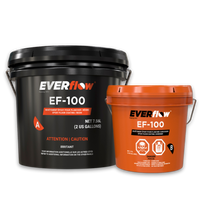
- EF-150 fast cure. Recoat 6 to 8 hours, foot traffic 8 to 12.
- EF-290 finish. Recoat 2 to 4 hours, foot traffic 3 to 6, so the bay reopens to people the same day.
- EF-301 finish. About one day to foot traffic, satin, and it goes over cured epoxy or urethane rather than bare concrete.
Foot traffic and aircraft traffic are not the same milestone and this is where hangar jobs go wrong. Walk on the times above. Do not roll an aircraft, a tug or a jack onto it until the full cure has passed, and get that figure off the data sheet for the exact product before you commit the bay. The practical pattern in a busy shop is bay by bay: one bay out, aircraft shuffled to the ramp or to a neighbour, build coat and finish inside the same day or overnight, then the bay sits for its cure while the crew moves to the next one.
The Florida constraint is the weather and the calendar. Afternoon storms mean the doors are shutting on short notice, and hurricane season fills every hangar on the field wingtip to wingtip, so bays stop being available from roughly June. The window for a hangar floor here is the dry season, and the operators who plan it in January get the schedule they want.
Prep, moisture and markings
Grind the whole floor to a clean sound profile, cut out and fill the old jack point patches properly rather than coating over them, and honour the joints. A hangar slab is a big plate with a lot of control joints, and a coating run straight across a moving joint splits in a neat line that looks exactly like a defect. EF-135 super fast cure crack filler handles the static cracks, and the moving joints get detailed rather than filled.
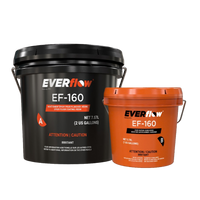
Slab moisture is the quiet killer here. Very few older hangar slabs have a vapour retarder under them, and a Florida water table plus a sealed floor is the classic blistering set up. Test before you buy material, and if the numbers say so, put EF-160 down first. Rework on a floor this size is not a small correction.
On markings and zoning, pigment lets you separate the maintenance bay, the walkways and the tow lane in colour instead of tape that peels. Quantities change with the build you specify, so work them out with the coverage guide rather than a rule of thumb, and pull the sheets from technical data sheets before the spec goes out.
Where to go next
This page sits under our commercial and industrial flooring overview. A hangar shares most of its engineering with a big warehouse, so warehouse floor coating is worth reading alongside it, and if the job is the adjoining maintenance shop see auto shop floor coating for the hot tyre and oil detail.