
Commercial and Industrial Epoxy Flooring
Commercial and industrial
Latux Epoxy has supplied and installed resinous floors in South Florida since 2004. Warehouses, plants, kitchens, shops and hangars. This page is for the person who has to keep the floor working: the facility manager who cannot lose a shift, the plant engineer who knows what gets spilled on that slab, and the commercial contractor pricing the job.
We supply and we install · Authorized dealer for every brand we carry · Contractor and distributor pricing · Local pickup in Pompano Beach · Free UPS Ground on orders over $150 · English, Spanish and Portuguese
Start here
A commercial floor is not a big garage floor
The resin is rarely what fails. What fails a commercial job is the slab underneath it, the moisture coming up through it, and the number of hours you were given to work. A 60,000 square foot distribution floor and a two-car garage can take the same product and end up in completely different places, because one of them got ground to profile, tested for vapor emission and coated in a planned shutdown, and the other one got rolled over a swept slab on a Saturday.
So the useful conversation is not which epoxy. It is what happens on that floor, how wet the slab is, and how long you can have it. Get those three right and the material choice mostly follows. The rest of this page walks through them, then tells you which system belongs in which room.
What changes at scale
Five things that decide a commercial floor
Surface preparation
Acid etching is a residential shortcut and it does not belong on a commercial slab. Commercial work is mechanically prepared, normally diamond ground to an open profile, shot blasted where the floor is large and flat enough to justify it. That means a planetary grinder sized to the room and HEPA dust collection running with it, because you are grinding concrete inside somebody's occupied building. Prep is also where the schedule is really set: on a big floor the machine decides how many square feet a day you get, not the resin.
Slab moisture
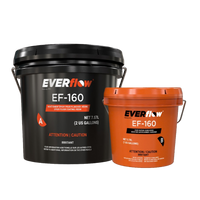
This is the single most common cause of a commercial coating letting go. Slabs on grade, below-grade rooms, slabs poured young, and anything with a compromised vapor retarder will push moisture up into the bond line and blister or delaminate the floor months after it looked perfect. The fix is not optimism, it is a test and then a barrier. We stock moisture vapor barrier products for exactly this: Everflow EF-160 is a 100% solids epoxy barrier rated to 25 lbs emission per 1,000 sq ft per 24 hours at 100% relative humidity, and Premera Easy MVB is a single-component water-based treatment that penetrates and seals the capillaries from inside. If you do not know your slab's number, test before you buy anything.
The downtime window
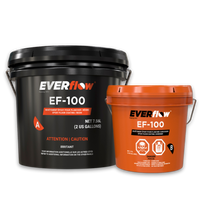
Most commercial jobs are sold or lost on hours, not on gloss. A plant that closes for one weekend needs a system that goes down Friday night and takes traffic Monday morning, and that is a chemistry decision made before the quote. Everflow EF-155 recoats in 2 to 4 hours, which is what makes a same-day build possible. EF-150 recoats in 6 to 8 and applies on substrates down to 32 degrees F, which matters in cold storage and on winter night work. On the wear course, EF-290 recoats in 2 to 4 hours and takes foot traffic in 3 to 6. Tell us your window first and we will work backwards to the build.
Thermal shock
Steam cleaning, hot wash-down, boiling spill, freezer floor, pressure washing at temperature. Concrete and epoxy expand at different rates, and repeated heat cycling is what pops a standard epoxy off a kitchen or plant floor at the drains first. Where that is the daily reality, the answer is urethane cement, not epoxy. PPC Krete Slurry SL is a four-component polyurethane mortar rated to 185 degrees F in service with 9,050 psi compressive strength and zero water absorption, poured at 1/8 to 3/16 inch so it moves with the slab instead of fighting it.
Chemical exposure
Ask what actually lands on the floor and how long it sits before anyone wipes it. Hydraulic oil and brake fluid in a shop bay, food acids and sanitizer in a plant, battery acid on a charging pad, solvents in a manufacturing cell. A 100% solids epoxy handles a great deal of it; a polyaspartic or polyurethane wear course on top handles abrasion and UV and makes the floor far easier to clean. Where the exposure is aggressive and constant, urethane cement is the honest recommendation even though it costs more, because replacing a failed floor costs more again.
Choosing the system
Match the build to what happens on the floor
| The floor | What we would put down | Why |
|---|---|---|
| Warehouse, distribution, racking aisles | 100% solids epoxy build coat plus a polyaspartic wear course | Forklift and pallet-jack abrasion, and a clear coat that reopens aisles fast |
| Food plant, beverage, brewery, dairy | PPC Krete urethane cement slurry and topcoat | Hot wash-down, food acids, sanitizer. Suitable for food and beverage production areas |
| Commercial kitchen and prep area | Urethane cement, or 100% solids epoxy with a broadcast finish away from the heat | Thermal shock at the drains is what kills kitchen floors |
| Cold storage, freezer, chill room | Urethane cement, or EF-150 fast cure where the room allows | Cold-substrate application and a floor that survives freeze and thaw cycling |
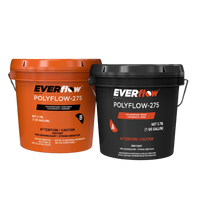
| Auto shop, truck bay, fleet maintenance | 100% solids epoxy base plus EF-275, EF-280 or EF-290 | Hot tire pickup, oil, coolant and brake fluid, bays back in service same day |
| Manufacturing with chemical exposure | 100% solids epoxy plus polyaspartic, or urethane cement where exposure is constant | Chemical resistance and a seamless surface with nothing to trap residue |
| Retail, showroom, lobby, hotel front of house | Metallic epoxy plus a UV-stable polyaspartic | It has to look expensive under glass and not yellow |
| Gym, studio, locker and rec room | Full flake broadcast plus polyaspartic | Nonporous, no grout to hold odor, and the flake texture gives you slip resistance |
| Damp slab, slab on grade, below grade | EF-160 or Premera Easy MVB first, then the system above it | Nothing bonds to a slab that is still pushing water |
| Hangar, hall, any very large open floor | 100% solids epoxy with a high-solids polyaspartic, staged in bays | Coverage and recoat timing have to fit the shutdown, not the other way round |
Cracks, joints and slab repair come before all of it. EF-135 crack filler takes foot traffic the same day, so a repair does not cost you a day of schedule. Primers and sealers are stocked for the layers in between.
Who we work for
The buildings these floors go into
We supply the material, and in South Florida we put the floor down ourselves. Either way, these are the rooms we spend our days in.
Warehouses and distribution centers
Racking aisles, dock areas, forklift traffic, line markings.
Manufacturing and industrial plants
Production floors, assembly areas, machine bases, chemical exposure.
Food and beverage production
Processing and packaging floors, breweries, bottling, dairy. Urethane cement is suitable for these areas.
Commercial kitchens and restaurants
Prep lines, dish areas, walk-ins, front of house.
Cold storage and walk-in freezers
Floors that cycle between temperatures and get washed down anyway.
Auto shops, truck bays and fleet garages
Lifts, drains, hot tires, oil and brake fluid.
Retail, showrooms and hotel lobbies
Seamless decorative floors that hold up to public traffic.
Gyms, studios and recreation facilities
Nonporous, cleanable, slip resistant where people sweat.
Schools, colleges and university facilities
Corridors, shops, kitchens, plant rooms. Summer shutdown work.
Medical, dental, veterinary and laboratory
Seamless floors with nothing to hold residue, and cove where it is called for.
Aircraft hangars and aviation facilities
Very large open slabs, fuel and hydraulic exposure, staged bays.
Firehouses and emergency services
Apparatus bays that have to look right and take diesel and tire heat.
Government, municipal and military facilities
Public works buildings, depots, motor pools, maintenance shops.
Car washes, parking decks and self-storage
Constant water, salt, and traffic that never really stops.
Below-grade rooms and basements
Where the slab moisture conversation has to happen first.
Preparation and equipment
On a big floor, the grinder sets the schedule
Square footage per shift is a machine number, not a resin number. We stock planetary grinders from walk-behind units up to remote-control and self-propelled machines, in electric and propane, plus the diamond tooling and the HEPA dust collection that has to run alongside them in an occupied building. We are an authorized dealer for Husqvarna, Lavina, HTG, Metabo and Metabo HPT, so warranty, parts and technical support come through us rather than through a third party.
- Floor Grinders
- Husqvarna / HTC Series
- Lavina
- HTG Series
- Dust Collectors & Vacuums
- Dust Extractors
- Cup Wheels & Diamond Tooling
- Application Tools
- Safety & PPE
The larger machines are quoted rather than listed, because freight, access and power supply change the number. Tell us the footage, the dock situation and what power is available on site. If you are still deciding, the grinder buying guide walks through sizing.
Buying at volume
Pricing, freight and pickup
Contractor and distributor pricing
We run three trade tiers, Contractor, Distributor and VIP. They are applied to your account rather than published as a public discount, so your pricing follows you at checkout on every order with no code to remember. Volume on resin, flake and pigment is where the tiers matter most. Apply for a trade account, or call and we will set it up on the phone.
Freight, delivery and pickup
Free UPS Ground on orders over $150. Under that, ground is charged by weight. Commercial quantities usually move on a pallet, and pallets and machines are quoted per job, because a grinder going to a third-floor job with no dock is not the same shipment as one going to a warehouse with a leveler. Local pickup at our Pompano Beach counter is available on everything we stock, normally same day if you call ahead.
Getting the quantities right
Coverage is different for every product in a system, so work it out per layer rather than per job. The coverage calculator handles the math and the waste factor, and every product's numbers are on its technical data sheet. If you would rather just read the footage to somebody, call (800) 413-1427 and we will build the material list layer by layer.
Two ways to work with us
Supplied, or supplied and installed
If you are a commercial flooring contractor, we are your supply house. You buy at tier, you pick up in Pompano Beach or we ship it, and you run your own crew. We will spec the build with you and tell you honestly when a cheaper system will do the job, because we would rather sell you the next floor as well.
If you are a facility manager or a general contractor and you do not want to find a crew, we install. Same company, same people on the phone, same material. Surface preparation, moisture testing, the coating system, line markings and cove where the job calls for it. Send us the drawings or the square footage and the shutdown window you are allowed, and we will come back with a scope.
Also serving: Miami, Fort Lauderdale, Boca Raton and West Palm Beach.
Every product we sell carries a free replacement commitment on material defects. Talk to us before the job rather than after it and you will rarely need it.
Before you specify
Worth reading first
Speak to a coatings expert
Tell us the floor and the window you have
Latux Epoxy
2201 N Andrews Ave, Suite 108
Pompano Beach, FL 33069
(800) 413-1427
Monday to Friday, 8:00 AM to 5:00 PM.
Saturday by appointment.
Sunday closed.