
Parking Garage Floor Coating for Ramps and Turning Lanes
Coating or membrane, and why it matters before you price anything
This is the question the whole job turns on. If the slab is on grade, water going through it is not a problem and you are buying a coating: abrasion resistance, UV stability, traction and appearance. If the slab is suspended over anything, water going through it is the entire problem, and what you actually need is a traffic bearing waterproofing membrane with crack and joint detailing and its own warranty structure. We stock one: the PSI deck waterproofing line, specified by quote. What we will not do is sell you a coating as a substitute for one. Being told this in week one is cheaper than being told it in year one.
Where a coating still belongs on a structure is the top of a deck that has already been waterproofed by others, where the owner wants wear and UV protection over the membrane, and the stair towers, elevator lobbies, valet lanes and ground floor.
What actually goes wrong on a garage floor
The joints and the cracks, first and always
A garage deck is a jointed plate that moves with temperature all day. Bridge a moving joint with a hard coating and it splits in a straight line, and the owner reads that split as a product failure when it is a detailing decision. Static cracks get chased out and filled. Moving joints get terminated into and re-established, not covered.
Tyre marks and pickup in the turning lanes
Straight driving barely touches a floor. Turning does. Every ramp mouth, every corner and every bay entrance is where the tyre scrubs sideways under load, and on a hot Florida afternoon that rubber is soft. That is the abrasion case, and it is why the wear coat and the traction coat concentrate at the ramps rather than spread evenly across the whole deck.
UV, and the one that catches people out
The top level and the first twenty feet inside every ramp mouth get real Florida sun. A clear epoxy will amber there and nowhere else, which looks like a staining defect rather than a coating choice. Our own MONEY COAT page states it: a clear epoxy can amber under prolonged UV, so it needs a UV stable polyaspartic over it. In a garage, use UV stable chemistry from the primer up.
Water, salt and the drain line
A coastal garage takes salt spray, blown rain and the runoff off every car that comes in wet. Water pools where the slope is wrong and stands along the drain line, and a coating that is going to fail will fail there first. Fix the pooling if you can, and if you cannot, at least put the traction finish where the water sits.
Downtime and cure, around a garage that cannot close
Manufacturer figures.
- EF-285 base. Recoat 2 to 4 hours, walk 4 to 8.
- EF-290 wear coat. Recoat 2 to 4 hours, foot traffic 3 to 6, so a level can reopen to people the same day.
- EF-301 traction finish. About one day to foot traffic. Goes over cured epoxy or urethane, not bare concrete.
Foot traffic is not vehicle traffic. Get the full cure figure off the data sheet for the exact product before you let cars back on, and do not let a property manager talk you into turning tyres on a floor that has only reached foot traffic. The fast recoat windows above are what make level by level overnight work possible, which is how most occupied garages get done: close one level at nine at night, prep, base, wear coat, and have it walkable by morning while the next level waits.
The Florida constraint on a garage is that it is effectively an outdoor job. Afternoon storms, blowing rain through open sides and overnight dew all sit on top of the schedule. The ramp mouths and the top level are the weather exposed parts and they are also the parts that matter most, so they get the good window and the interior levels get the marginal one. Hurricane season compresses everything because a garage fills up when a storm is called.
Prep, slope and slab moisture
Diamond grind to a clean sound profile at CSP-2 for the polyurea base. On an older deck expect to find previous coatings, tyre rubber build up in the lanes and oil staining at the bays, all of which comes off rather than gets coated over. Extraction and containment keep the dust out of the cars on the levels you are not working on.
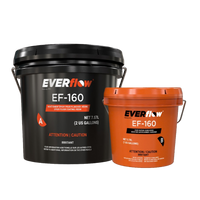
Slab moisture matters less on a suspended deck than on grade, but it matters a great deal on the ground floor of a Florida garage, where a slab poured on grade with no vapour retarder is common and the water table is high. Test it. If the numbers call for it, the EF-160 moisture vapor barrier handles emission up to 25 lbs per 1000 sq ft per 24 hours at 100% relative humidity. Note the EF-285 page's own condition: it bonds to diamond ground concrete at CSP-2 with a moisture barrier.
Quantities vary with how many coats the deck takes and how much of it gets the traction finish, so work it out with the coverage guide and pull the sheets from technical data sheets. If you are still choosing between chemistries, epoxy vs polyaspartic covers the trade offs.
Where to go next
This page sits under our commercial and industrial flooring overview. If the space is a service garage rather than a parking garage, see auto shop floor coating. For the warehouse or distribution floor behind it, see warehouse floor coating.