
Warehouse Floor Coating
Bare concrete in a warehouse does not stay bare for long. Forklift wheels polish the traffic lanes, dust from the slab settles on inventory, and spalled patches at the dock doors grow into wheel-jarring holes. A coated floor fixes all three at once: it seals the slab, takes the abrasion in place of the concrete, and gives you a bright, cleanable surface that bounces light back into the racking aisles.
Why 100% solids epoxy under a polyaspartic wear course
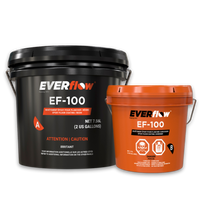
The build that survives hard-wheel traffic is a two-layer system. A 100% solids epoxy base does the structural work. EF-100 cures to 6,200 psi compressive and 5,500 psi tensile strength with a Taber abrasion loss of 0.1 g (CS-17, ASTM D4060), and it carries 0 flame spread in fire testing. Because it is 100% solids, everything in the bucket becomes floor. Nothing evaporates, so it builds a real wear film in one pass. One 3-gallon EF-100 kit covers 150 to 200 square feet as a base coat. Primer and topcoat layers cover differently, so work each layer out with the coverage guide.
Over that base, a polyaspartic wear course takes the daily hits. EF-290 is a 90 percent solids clear that wears at just 0.03 g Taber loss, roughly a third of the base coat, so the color layer underneath stays protected. EF-280 trades some film build for coverage, about 600 square feet per 3-gallon kit, which makes it the economical wear course on big open floors.
The downtime math
On a working warehouse the real cost is not the coating, it is the closed aisle. This is where the fast-cure chemistry earns its price. EF-150 shortens the base-coat recoat window, and EF-290 recoats in 2 to 4 hours, takes foot traffic in 3 to 6, and carries vehicle traffic in about a day. Prep Friday night, coat Saturday, run forklifts Monday. On floors that cannot close at all, section the space into bays and rotate: rack one bay out, grind and coat it, move to the next.
Line markings and prep
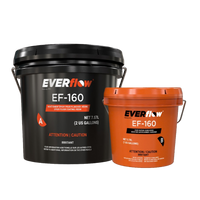
Aisle striping goes down after the color coat and under the clear wear course, so the lines are sealed into the system instead of scrubbing off the surface. Prep is not optional at warehouse loading: diamond grind the slab to ICRI CSP-2 so the base coat keys into open concrete. If the slab sits on grade and reads damp, put EF-160 moisture vapor barrier down first so slab moisture cannot lift the system later.
Grinders and dust control
Warehouse footage calls for real prep equipment, and we supply that side too. Machines like the HTG-820RC remote-control grinder and the Husqvarna PG 8 S cover large slabs fast, with a HEPA dust collector keeping silica out of the air and off the inventory. Machine purchases run on a quote basis, so tell us the footage and we will spec the right unit for the job. Not sure which machine? Read how to choose a concrete floor grinder.
Sizing the job
Work from measured square footage, not the lease number. The coverage guide walks through the kit math, and the contractor material takeoff shows how to build a full material list layer by layer. Or skip the homework and shop the epoxy floor coatings line directly.
Talk to a coatings expert
Every warehouse floor is a different mix of traffic, chemistry, and downtime pressure. Call us at (800) 413-1427 with your square footage, traffic type, and schedule window, and we will put together a system spec and material list for the job.
Related guides: epoxy vs polyaspartic for choosing your layers, and the auto shop floor guide if there is a maintenance bay on site.