
Running short in the middle of a pour is one of the worst things that can happen on an epoxy job. The resin is already mixed, the clock is running, and a fresh batch is either not on the truck or not going to blend into a wet edge cleanly. Most of the time the problem is not the product. It is a takeoff that treated the floor as one number instead of a stack of separate coats, each with its own coverage.
This is the contractor method for estimating epoxy the way you would price any material takeoff. Measure the real slab, pick your system, then size the primer, the base, and the topcoat as three different orders. If you just want a fast number for a standard garage, use our how much epoxy do I need quick reference chart. This guide is the deeper walkthrough for a full system, odd-shaped rooms, and jobs where being off by a kit costs you a day.
Step 1: Measure the real square footage
Coverage math is only as good as the number you feed it. A clean rectangle is easy. Length times width and you are done. Real floors are rarely clean rectangles, so break the space into shapes you can measure and add them up.
- L-shaped and T-shaped rooms: split the floor into two or three rectangles, calculate each, then total them.
- Angled or bay areas: a triangle is base times height divided by 2. A rounded nose can be measured as a rectangle if you are willing to carry the small overage as extra cushion.
- Columns, equipment pads, and floor drains: do not subtract them unless they are large. A single column footprint is a rounding error, and the extra material is cheap insurance.
- Cove base or a few inches up the wall: if the spec calls for coating up the wall, measure that band as its own rectangle (perimeter length times the height you are coating) and add it.
Write the total down. That square footage is the base of every calculation that follows.
Step 2: Set your coverage per coat
Epoxy coverage is not a fixed number per kit. It changes with how thick you lay it, and thickness is measured in mils (thousandths of an inch). This is the single fact that trips up most first estimates. A primer coat and a base coat use the same product at very different rates.
The formula behind it is straightforward for a 100% solids product:
Coverage per kit (sq ft) = kit gallons x 1,604 divided by mils.
The 1,604 comes from one gallon of 100% solids resin spread one mil thick. That formula is what you reach for when a spec dictates a film build. For everyday takeoffs, work from the square footage per kit that Latux publishes for each coat, which is how the systems we sell are quoted:
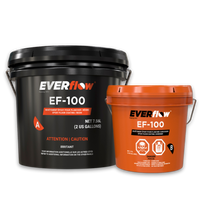
- Primer coat: thin and fast. EF-100 stretches to 480 to 600 sq ft per 3-gallon kit as a primer.
- Solid or garage base coat: 150 to 200 sq ft per 3-gallon EF-100 kit. Lean toward 150 on freshly ground or porous concrete and toward 200 on a tight, previously coated slab.
- Metallic coat: a metallic build is thick. EF-Masterflow covers about 160 sq ft per 4-gallon kit at 40 mils.
- Flake broadcast system: the epoxy base is the same 150 to 200 sq ft per 3-gallon kit, with roughly 25 lb of 1/4 inch flake per 125 to 175 sq ft broadcast to refusal.
Pick the system for the job before you calculate anything. A showroom metallic and a warehouse base coat are different products at different thicknesses, and they will never share a coverage number.
Step 3: Size each layer as its own order
A finished floor is a stack. Moisture barrier, primer, base, then topcoat. Each layer is a separate takeoff, and skipping one is how a job runs short. Treat your square footage as the constant and divide it by that layer's coverage.
Moisture vapor barrier
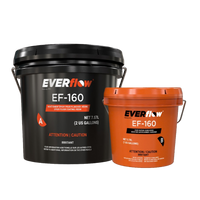
If your slab is on grade, below grade, or you got a high moisture reading, the first coat down is a barrier. Skipping this test is how good floors peel later, which we cover in the moisture vapor barrier guide. EF-160 covers about 264 sq ft per 3-gallon kit. Divide your square footage by 264 and round up.
Base coat
This is the color and body of the floor. Use the coverage for your chosen system from Step 2. For a solid garage floor, that is 150 to 200 sq ft per EF-100 kit. For a metallic, it is the base color under the Masterflow, which is a separate order from the metallic coat itself.
Topcoat
Raw epoxy ambers under UV and scratches easier than a proper finish, so a clear topcoat is not optional. EF-290 polyaspartic covers about 400 sq ft per 2-gallon kit. A polyurethane finish like EF-301 lands in the same range, close to 400 sq ft per gallon. Size the topcoat off the same square footage, not off how much base you happened to buy.
Step 4: Add for waste and rough concrete
The formula gives you theoretical coverage on a perfectly flat, sealed surface. Real slabs drink resin. Add a cushion on top of every layer:
- Smooth, previously coated, or steel-troweled slab: add 10%.
- Rough, ground, or acid-etched concrete: add 15 to 20%. A freshly ground profile has open pores and texture that pull more material into the surface than a flat number predicts.
Apply the cushion before you round up to whole kits. A porous slab can swing a three-kit job into a four-kit job, and finding that out on paper is a lot cheaper than finding it out on your knees with a wet edge going off.
A worked example: 400 sq ft rough garage, solid system
Say you have measured a two-car garage at 400 sq ft, the slab is freshly ground, and it needs a moisture barrier under a solid-color system with a polyaspartic topcoat. Here is the full takeoff, layer by layer, with a 15% rough-concrete cushion.
- Moisture barrier (EF-160): 400 x 1.15 = 460 sq ft to cover, divided by 264 = 1.7. Order 2 kits.
- Base coat (EF-100): 460 divided by 150 to 200 sq ft per kit = 2.3 to 3.1, so 3 to 4 kits. This slab is freshly ground, so take the thirsty end and order 4.
- Topcoat (EF-290): 460 divided by 400 = 1.15. Order 2 kits.
Notice that no single number describes this floor. The same 400 sq ft needed three different quantities because each coat has its own coverage. That is the whole point of a takeoff. For a metallic version of the same garage, the Masterflow coat alone would be 400 divided by 160, which is 2.5, so 3 kits just for the metallic, on top of a separate base and topcoat.
Shop by garage size: if the job is a garage, we grouped the base kits, pigment pods, topcoats, flakes, and tools each size needs into one page: 1-car garage epoxy kit, 2-car garage epoxy kit, and 3-car garage epoxy kit.
Common estimating mistakes that cause a job to run short
- Using one coverage number for the whole system. Primer, base, and topcoat are not interchangeable. Calculate each.
- Estimating a thick build at thin-build coverage. A metallic pour spreads about 40 sq ft per gallon, against 50 to 67 sq ft per gallon for a garage base coat, and it still sits on a separate base coat. Match the coverage to the coat.
- Ignoring the slab profile. A ground floor is thirsty. The 10% cushion for smooth concrete will leave you short on a rough one.
- Rounding down. Always round up to whole kits. A partial kit you cannot buy is a partial kit you cannot pour.
- Forgetting the wall band or cove. If the spec goes up the wall, that area is real square footage. Measure it.
- Trusting a number without checking the slab. Prep drives everything. Read the prep guide before you order, because a bad profile changes both your waste factor and whether the floor sticks at all.
Want the exact takeoff done for you?
The math above is the professional method, and doing it by hand keeps you sharp on why each number lands where it does. If you would rather have it calculated exactly for your square footage and build, our Pro Coverage Calculator runs every layer for you when you sign in to your Pro account. Enter the floor, pick the system, and it returns kit counts per coat with the waste factor already applied. For a quick standard-garage answer without signing in, the coverage reference chart has you covered.
More free tools inside your Pro dashboard
The Coverage Calculator is one of several free tools for Latux Pro members. Log in to your Pro account and the full set is there whenever you are pricing a floor:
- Coverage Calculator: an exact kit-by-kit takeoff by film build, surface profile, color, and topcoat.
- Product Selector: a short quiz that recommends a full system for your job.
- Color Charts: a metallic and solid-tone color picker.
- Project Estimator: turns your takeoff into a priced project list.
Every one of them is free to use. Set up a Pro account and you have the whole toolkit on hand for the next bid.
Frequently asked questions
How do I measure an irregular or L-shaped floor?
Break the floor into simple rectangles and triangles, measure each one, then add them together for your total square footage. A rectangle is length times width. A triangle is base times height divided by 2. Do not subtract small features like columns or floor drains. The little bit of extra material is cheap insurance against running short.
How much extra epoxy should I buy for waste?
Add 10% on a smooth, sealed, or previously coated slab. Add 15 to 20% on rough, ground, or acid-etched concrete because the open profile pulls more resin into the surface. Apply the cushion to each coat before you round up to whole kits.
Do the primer and topcoat use the same amount as the base coat?
No. Each layer has its own coverage. A primer coat of EF-100 spreads thin and stretches to 480 to 600 sq ft per kit, while a base coat covers 150 to 200 sq ft per kit. A polyaspartic topcoat like EF-290 covers about 400 sq ft per 2-gallon kit. Always size each coat separately off your total square footage.
How much epoxy do I need for a 2-car garage?
A typical two-car garage runs around 400 to 500 sq ft, which at 150 to 200 sq ft per EF-100 kit usually means 3 to 4 base-coat kits plus a separate topcoat, and a moisture barrier if the slab needs one. Because the exact count depends on your slab condition and how heavily you build the coat, use the coverage chart on our how much epoxy do I need page for a standard answer, or the Pro Coverage Calculator for an exact per-coat takeoff.
Why did my epoxy run short?
The most common reasons are using one coverage number for the whole system instead of calculating each coat, estimating a thick build like a metallic at thin-build coverage, and not adding enough waste for a rough or ground slab. Round up to whole kits and size the primer, base, and topcoat as separate orders to avoid it.
Knowledge that builds better floors.
Browse the full library of contractor guides, how-tos, and product insights.