
Industrial Epoxy Flooring
Industrial floor coatings
Industrial epoxy flooring is a resin system built thick enough and bonded hard enough to live under forklifts, dropped parts, chemical spills and wash-down. Latux Epoxy supplies industrial floor coatings to contractors everywhere we ship and installs them in Broward, Miami-Dade and Palm Beach. This is the plant side of our commercial and industrial flooring overview: exposure, thickness, prep at scale, and how to spec a system.
We supply and we install · Authorized dealer for every brand we carry · Contractor and distributor pricing · Local pickup in Pompano Beach · Free UPS Ground on orders over $150 · English, Spanish and Portuguese
Start here
Industrial floor coatings: what makes a floor industrial
Exposure, not square footage. A clean distribution hall with rubber-tire forklifts is a big commercial floor. A machining cell with coolant on the slab, steel-wheel carts and parts hitting the floor all shift is an industrial floor, and it needs a different build.
Before anyone talks product, write down what rolls on the floor, what gets dropped and spilled on it, whether it sees heat or a hose, and how many hours you can have the room. Those answers pick the system.
Traffic and impact
Forklifts, steel wheels and point loads
Abrasion is a wear-course job
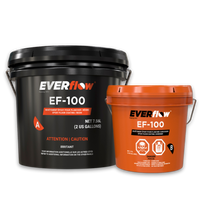
Forklifts grind hardest at turns, dock plates and aisle ends. A clear wear course takes that wear instead of the color. EF-290 loses 0.03 g in Taber abrasion testing (CS-17) against 0.1 g for the EF-100 epoxy base, and it is aliphatic, so it does not amber at a sunny dock door. Where gloss shows every scuff, EF-301 is a satin polyurethane at 0.02 g.
Impact and point loads
Dropped tooling, rack feet and machine bases load a tiny footprint very hard, so look at compressive strength. EF-100, EF-150 and EF-155 cure to 6,200 psi. LTX-100 cures to 18,400 psi, roughly three times a standard 100% solids floor epoxy, at 10 to 32 mils per coat. Steel wheels and dragged pallets gouge a thin film, so build those floors up. Where impact comes with water and heat, urethane cement at 3/16 inch is the build for kegs, carts and dropped tooling.
Chemical exposure
Chemical resistant floor coating: acids, caustics, solvents and oils
Chemical resistance depends on the chemical, the concentration, the temperature and how long it sits. Bring us that list for every room.
Oils, hydraulic fluid, coolant and fuel
100% solids epoxy floor coatings under a polyaspartic wear course handle this in machine shops and maintenance bays. The closed surface keeps oil out of the concrete.
Acids and caustics on a wash cycle
Food acids, lactic acid in a drain, hot caustic sanitation. When the floor sees both ends of the pH scale on one shift, with hot water, that is urethane cement territory.
Solvents and concentrated acids
We do not guess. Give us the chemical and the concentration and we check it against the manufacturer's resistance data, in writing, before we commit a system.
Heat and water
Thermal shock and wash-down
Steam, hot wash-down and freezer thresholds swing slab temperature fast, and a thin epoxy film eventually lets go. PPC Krete Slurry SL goes down at 1/8 to 3/16 inch, rated 26.5F to 185F in service, with 0% water absorption, finished with a cove up the wall and a keyway at every drain. The urethane cement flooring guide covers the build and the budget.
Thickness
How thick is industrial epoxy flooring?
Thickness is measured in mils, thousandths of an inch. For a 100% solids product, one gallon at one mil covers 1,604 sq ft, so coverage per kit is kit gallons times 1,604, divided by the mils you spec. Nothing evaporates: a 16 mil pour measures 16 mils when it is hard.
| Layer | Typical build | Product |
|---|---|---|
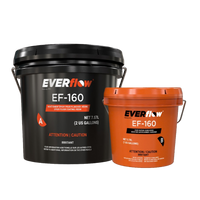
| Moisture vapor barrier | 18 mils, about 264 sq ft per 3-gallon kit | EF-160 |
| Epoxy primer pass | 8 to 10 mils | EF-100, LTX-100 |
| Epoxy build coat | 10 to 32 mils per coat, 16 standard | LTX-100 |
| Flake broadcast to refusal | About 25 lb of 1/4 in flake per 125 to 175 sq ft | Flake systems |
| Clear polyaspartic wear course | 8 mils over a coating, 12 over flake | EF-290, EF-280 |
| Urethane cement slurry | 1/8 to 3/16 inch, roughly 125 to 190 mils | Krete Slurry SL |
Specify mils per coat and check them with a wet-film gauge. Heavier trowel-applied mortars for extreme thermal shock are sourced to order.
Slab preparation
Prep at plant scale
Shot blast or grind
The Everflow epoxies call for a diamond grind to ICRI CSP-2. LTX-100 takes a grind or a shot blast to CSP 2 to 3. Urethane cement needs an enclosed shotblast to CSP 2 to 3, deeper than a grind. Shot blasting earns its place on large, flat, open floors; edges and tight rooms still get ground. A freshly blasted profile drinks resin, so add 10 to 20 percent to the material.
Cracks and joints
Static cracks get chased and filled. EF-135 is an 8,700 psi epoxy paste that runs about 1,100 linear feet per gallon on 1/8 by 1/8 inch cracks and recoats in 2 to 4 hours at 68F. Moving control joints are honored, not bridged. Coat across one and it splits in a clean line that looks like a product failure.
Slab moisture
Test before you buy. The long-standing limit for standard epoxy is 3 lb per 1,000 sq ft per 24 hours on a calcium chloride test (ASTM F1869). From 3 to 25 lb, EF-160 goes down first. Above 25 lb, or with liquid water, fix the water source before any coating. The Krete Slurry SL page states that moisture testing is not required before install. See the moisture testing guide.
Machines and dust
On a plant floor the grinder sets the schedule. Open slabs want 24 to 33 inch machines, and a remote unit like the HTG-820RC (32 inch, three phase at 240 V 60 A or 480 V 40 A) keeps the operator off the deck. HEPA extraction runs the whole time in an occupied plant. The grinder buying guide covers sizing and power.
Downtime
Cure windows and shutdown planning
Manufacturer figures at 68F for Everflow and LTX-100, 72F for Krete. Cold slows all of them.
| Product | Recoat | Foot traffic | Vehicles or heavy traffic | Full cure |
|---|---|---|---|---|
| EF-155 epoxy | 2 to 4 hr | 6 to 8 hr | About 1 day | About 7 days |
| EF-150 epoxy | 6 to 8 hr | 8 to 12 hr | About 1 day | About 7 days |
| EF-100 epoxy | 18 to 24 hr | About 1 day | About 2 days | About 7 days |
| LTX-100 epoxy | Within 4 days at 75F | 16 hr | 3 days | 7 days |
| EF-290 polyaspartic | 2 to 4 hr | 3 to 6 hr | About 1 day | About 7 days |
| Krete Slurry SL | Topcoat within 24 hr, no prep | 12 hr | 24 hr | 5 days chemical |
| Krete Topcoat | Final coat | 24 hr, light | Not stated | 7 days chemical |
Foot traffic and forklift traffic are different milestones; put forks on at the foot-traffic time and you mark a floor that is not cured. Where the plant cannot close, go bay by bay. EF-150 and EF-155 apply on substrates down to 32F. Krete cannot go down below 50F and the floor stays above 40F for 24 hours. Keep full-strength caustic off new urethane cement until its chemical cure has passed.
Specifying the system
Specifying industrial epoxy floor coatings by exposure
| What the floor sees | What we would spec | Why |
|---|---|---|
| Dry storage, racking aisles, rubber-tire forklifts | 100% solids epoxy with an EF-290 or EF-280 wear course | The clear coat takes the abrasion |
| Point loads, dropped parts, machine bases | LTX-100 at a heavier build, polyaspartic over it | 18,400 psi compressive |
| Oil, hydraulic fluid, coolant, fuel | 100% solids epoxy with EF-290, or satin EF-301 in maintenance bays | Closed surface; EF-301 adds about 0.80 wet DCOF |
| Acids and caustics with hot water, steam or CIP | Krete Slurry SL, Krete Topcoat with a silica broadcast | 26.5F to 185F service, 0% water absorption |
| Concentrated acids or solvents standing on the floor | Checked against manufacturer resistance data first | Resistance is chemical and concentration specific |
| Freezer thresholds, chilled docks | Urethane cement; EF-150 or EF-155 on dock aprons | Thermal cycling at the door; fast cure applies down to 32F |
| Slab on grade over 3 lb | EF-160 first, then the system | Rated to 25 lb per 1,000 sq ft per 24 hours |
| Must reopen next morning | EF-155 build coat, EF-290 wear course | 2 to 4 hour recoats |
| Wet underfoot | Flake to refusal in epoxy, or silica at about 0.4 lb per sq ft in the Krete topcoat | Smooth urethane cement tests 25 wet on the pendulum |
Most plants are two buildings at once: urethane cement on the wet side and the drains, epoxy with a wear course on the dry side. That split is where the budget comes back.
Safety and marking
Safety colors, aisle lines and traction
Zone the floor in color instead of tape that peels. EF-100 comes in six stock colors and pigment covers the rest. Aisle lines go down after the color coat and under the clear, so they are sealed in. EF-290 tests about 0.75 DCOF wet; EF-301 about 0.80.
Budget
What industrial epoxy flooring costs per square foot
We price industrial floors by the job, because the resin is rarely the big number. What moves the price per square foot:
- Prep and repair. Old coatings off, cracks chased, spalled joints and dock edges rebuilt.
- Moisture. A barrier is a full extra layer and a day of cure.
- Thickness. Urethane cement is an order of magnitude more material than a 10 to 20 mil film and lands several times higher than epoxy.
- The window. Night work and bay sequencing cost more than an open week.
- Footage. Bigger floors come in lower per square foot, because setup spreads over more area.
The contractor takeoff guide and coverage calculator size each layer, and every product's numbers are on its technical data sheet.
By facility
Industrial floors, room by room
Warehouses and distribution
Forklift aisles, dock plates, line markings.
Food and beverage plants
Wash-down, drains, a split wet and dry spec.
Cold storage and freezers
Door lines and thermal shock at the dock.
Breweries and distilleries
Caustic, lactic acid, kegs and hot liquor.
Aircraft hangars
Jack point loads, hydraulic fluid, huge slabs.
Parking garages
Turning lanes, UV at the ramps.
Truck bays and fleet maintenance
Hot tires, oil, coolant, brake fluid.
Two ways to work with us
Supplied anywhere we ship, installed in South Florida
We install industrial floors in Broward, Miami-Dade and Palm Beach counties, prep through line markings. Outside those three counties we work with a network of installers across the US.
For contractors, we are the supply house: free UPS Ground over $150, freight quoted on pallets and machines, pickup at our Pompano Beach counter, and trade pricing through a trade account. Failing floor already? Start at epoxy floor problems, or compare epoxy vs polyaspartic.
Straight answers
Common questions
What is industrial epoxy flooring?
A 100% solids epoxy system over mechanically prepared concrete, built for plant traffic: a primer or moisture barrier, one or more build coats, and a polyaspartic or polyurethane wear course. Where the floor sees steam, hot wash-down or constant acids and caustics, the answer is urethane cement at 1/8 to 3/16 inch instead.
How thick should an industrial epoxy floor be?
Count it layer by layer. An epoxy build coat goes down at 10 to 32 mils depending on the product, a clear polyaspartic wear course at 8 to 12 mils, and a moisture barrier at about 18 mils. Urethane cement is 1/8 to 3/16 inch, roughly 125 to 190 mils.
How much does industrial epoxy flooring cost per square foot?
We price by the job, because prep, repair, moisture, thickness and the shutdown window drive the number more than the resin. Large floors cost less per square foot than small ones, and urethane cement lands several times higher than epoxy.
Will an epoxy floor hold up to forklifts?
Yes, on a ground slab with a 100% solids build coat and a wear course. EF-290 loses 0.03 g in Taber testing against 0.1 g for the EF-100 base. Keep forklifts off until the vehicle cure time has passed, not the foot traffic time.
Epoxy or urethane cement for a manufacturing plant?
Epoxy for dry process, assembly, storage and maintenance areas at ambient temperature. Urethane cement where the floor sees steam, hot sanitation, fast temperature swings, or acids and caustics every shift. Most plants need both.
How long does the floor have to be shut down?
EF-155 recoats in 2 to 4 hours, so a full epoxy build can go down in one day, and EF-290 takes foot traffic in 3 to 6 hours. Vehicles wait about a day. Krete Slurry SL takes heavy traffic in 24 hours and reaches full chemical cure in 5 days at 72F.
Shot blasting or diamond grinding?
Everflow epoxies call for a diamond grind to ICRI CSP-2. Urethane cement needs an enclosed shotblast to CSP 2 to 3, which is deeper. Shot blasting pays on large open floors; edges and tight rooms still get ground.
Do you install industrial floors outside South Florida?
We install in Broward, Miami-Dade and Palm Beach counties. Outside those we work with a network of installers across the US, and we supply material and equipment anywhere we ship.
Speak to a coatings expert
Tell us the floor, the exposure and the window
Latux Epoxy
2201 N Andrews Ave, Suite 108
Pompano Beach, FL 33069
(800) 413-1427
Monday to Friday, 8:00 AM to 5:00 PM.
Saturday by appointment.
Sunday closed.