
Epoxy Flake Flooring Systems
Flake flooring
A flake floor is a coating system, not a product. Vinyl chip is broadcast into a wet epoxy base coat, the loose chip is scraped back, and a clear polyaspartic topcoat seals the whole thing into one surface. It hides a tired slab, builds its own grip, and shrugs off the scuffing that shows on a plain colour floor within a season. This page covers how the system goes down, what a full broadcast really costs you in material and labour, and the two or three jobs where it is the wrong call.
- 1/4 in vinyl chip
- 8 colour blends
- Full or partial broadcast
- 25 lb and 40 lb boxes
- Polyaspartic topcoat
- Free UPS Ground over $150
- Pickup in Pompano Beach
What a flake floor actually is
The chip is decorative vinyl. It is not the wear surface, it carries no structural load, and on its own it would sweep straight off the slab. What holds it is the epoxy underneath and the polyaspartic on top. Thrown into the base coat while the resin is still wet, the chip sinks part way in, locks as the epoxy cures, and stands proud of the surface by a fraction of a millimetre. The topcoat then floods over the top and fills between the chips until the floor reads as one continuous surface with the colour suspended inside it.
That build is why a flake floor behaves the way it does. Because the colour is thousands of small pieces rather than one flat field, the eye stops reading the slab underneath it. A ghost of an old crack repair, a patched saw cut, a section poured on a different day, all of it disappears under a full broadcast. A solid colour floor does the opposite. It is a flat plane, and a flat plane shows every imperfection in the concrete under it, including the ones that were not visible before you coated it.
The same texture that hides the slab also does something useful underfoot. The chip edges break up the surface enough to give a natural grip profile without anyone adding grit to the topcoat. On a garage floor that gets wet, or a shop floor that sees the odd oil drip, that matters more than it sounds.
How the system is built up
1. Prep the slab
Mechanical prep, every time. A diamond grind opens the concrete so the primer or base coat can key into it. Acid etching is not prep, it is a wash, and it is the single most common reason a garage floor peels in year two. Grind to a consistent profile, vacuum properly, and check the slab for moisture before anything goes down.
2. Prime and patch
A primer wets the concrete out, kills pinholing, and gives the base coat something better than bare dust to bond to. Cracks and static joints get filled and cured before the base coat, because a crack that moves under a flake floor will telegraph straight through the chip.
3. The base coat
This is the layer that holds the chip, so it has to still be wet when the flake lands. On a large floor that means working in bays and keeping a wet edge, and on a hot South Florida slab it can mean a fast cure resin so the crew is not fighting the pot life. The base coat is usually pigmented, because with a partial broadcast the base colour shows through and becomes part of the finish.
4. Broadcast the flake
Thrown upward and let fall, not scattered sideways. Thrown up, the chip lands flat and random. Thrown across, it lands on edge and in streaks, and streaks in a flake floor cannot be fixed afterwards. Full broadcast means keeping the chip coming until the floor will not take any more, which is where the phrase broadcast to rejection comes from.
5. Scrape, then topcoat
Once the base has cured, the loose chip gets scraped back with a floor scraper and the whole floor is vacuumed. This step is unglamorous and it decides how the floor feels underfoot. Then the polyaspartic goes on, usually two coats, and it is the topcoat you are actually walking on.
Full broadcast or partial, and what it changes
This is the decision that drives everything else on a flake job, and most of the time nobody explains it to the customer before the material is ordered.
Full broadcast to rejection means you keep feeding chip into the wet base coat until the floor physically will not absorb any more. The result is a floor where the base coat is invisible. You see chip, edge to edge, with a pronounced texture underfoot. It is the finish most people picture when they hear flake floor, it is the one that hides a bad slab completely, and it is also the one that eats material. It takes more chip, it takes more topcoat because the rough surface has more area to cover, and it takes longer to scrape.
Partial broadcast means you are placing chip into the base coat at a chosen density and letting the base colour show between the pieces. The floor reads as a coloured floor with flake in it rather than a floor made of flake. It is smoother underfoot, it uses a fraction of the chip, and it goes down faster. What it will not do is hide a slab. Whatever the base coat shows, the finished floor shows, so partial broadcast belongs on concrete that is already in reasonable shape.
The material difference is not marginal. These are the figures from our own flake product pages, and the box size is named on every line because it is not the same number for both boxes.
| Broadcast density | 25 lb box | 40 lb box |
|---|---|---|
| Full broadcast, to rejection | 125 to 175 sq ft | 200 to 280 sq ft |
| Partial broadcast | 625 to 1,250 sq ft | 1,000 to 2,000 sq ft |
| Light accent scatter | 1,250 to 5,000 sq ft | 2,000 to 8,000 sq ft |
Source: the 25 pound box and the 40 pound box product pages, which follow the manufacturer flake data sheet. Yield moves with technique, with the base coat you are broadcasting into, and with how heavy you build the density, so treat the range as a range.
Read those rows next to each other and the practical point lands on its own. A single 40 pound box will full broadcast a small two bay floor, or partial broadcast a warehouse aisle. Ordering for a full broadcast and then running partial leaves you with boxes on the shelf. Ordering for a partial and then deciding on site that you want full is the version that stops the job, because the second box has to match the first and a blend run is not guaranteed to match between production batches.
Flake size and blends
Chip size sets the scale of the pattern. The boxes we stock are 1/4 inch vinyl chip, which is the size most residential and light commercial flake floors use. It is large enough to read as a deliberate pattern from standing height and small enough to lie flat and topcoat cleanly. Smaller chip gives a tighter, more uniform look that reads closer to terrazzo from a distance and needs a heavier topcoat to bury. Larger chip gives a bolder, more broken pattern that photographs well and shows lap lines more easily if the broadcast is not even.
We carry eight blends: Basalt, Cabin Fever, Carbon, Domino, Nightfall, Orbit, Outback and Shoreline. Every one is genuine Torginol polymer flake. Both box sizes list all eight, but stock varies by blend and box size. See every blend side by side, with stock by box size, on our epoxy flake colors chart.
One piece of advice that saves arguments. A blend chosen on a screen is not a blend chosen on a floor. Flake blends shift noticeably under different light, and the same blend that looks charcoal grey under shop fluorescents can read distinctly blue under daylight through a roller door. Lay a handful of the actual chip on the actual slab, in the light the floor will live under, before ordering for a whole job. If you are supplying a customer rather than installing for yourself, get them to sign off on the chip in the room.
The base coat colour matters more than most people expect, too. At a full broadcast it barely shows, so pick it for coverage rather than looks. At a partial broadcast the base is half the finished colour, and a chip blend that looks right over grey can look wrong over tan. Epoxy pigments cover the base coat side of that decision.
What a flake floor costs you compared to a solid colour
Straight comparison, no prices, because prices move and the trade off does not.
More material. A flake floor is the same base coat as a solid colour floor, plus the chip, plus more topcoat than a smooth floor needs because the broadcast texture increases the surface area the topcoat has to cover. At a full broadcast the topcoat difference is real and it is usually the line people forget when they price the job.
More labour, and one more day. A solid colour floor is prep, prime, coat, topcoat. A flake floor adds the broadcast itself, which needs a second person on a floor of any size, and it adds the scrape, which is physical work over the whole floor with nothing to show for it visually. On most jobs that pushes a two day schedule to three.
Less forgiveness on the day. The chip has to go into wet resin, so the base coat sets your working window and you cannot pause. On a warm slab that is a genuine constraint, which is why fast cure and standard cure base coats both exist and why the choice between them is a scheduling decision as much as a chemistry one.
And then it outlasts the solid colour floor visually. That is the whole return. A solid colour garage floor shows tyre marks, dropped tools and hot tyre pickup as individual events, because there is nothing in the surface to break them up. A flake floor absorbs all of that into the pattern. Five years in, the flake floor that cost an extra day still looks like a finished floor, and the solid colour one looks like a floor that has been worked on.
If you are weighing the topcoat side of this rather than the flake side, epoxy versus polyaspartic covers that comparison directly.
Where a flake floor belongs
It is the right answer more often than not on:
- Garages. The original use case, and still the best one. Hides a slab that has seen twenty years of oil and salt, grips when wet, and takes hot tyre contact better than a plain colour coat.
- Basements. Forgiving over the patchy, previously coated concrete that basements usually have, and the texture helps where the floor gets damp. See basement floor coating.
- Shops and home workshops. Dropped tools and dragged benches disappear into the pattern instead of leaving a record of themselves.
- Gyms and fitness rooms. Good grip, easy to clean, and it survives dropped weights better than a smooth coat. See gym floor coating.
- Light commercial and back of house. Corridors, storage, break rooms, anywhere that needs to look finished without being precious.
Where it is the wrong call
- Heavy forklift traffic with point loading. A loaded forklift wheel concentrates load in a small contact patch and will crush the chip layer regardless of how good the topcoat is. That floor wants a thicker built system, not flake. Warehouse floor coating covers it.
- Washdown areas that need a seamless cove. Kitchens, food processing, anywhere with a floor drain and a hose. The requirement there is a monolithic surface running up the wall with no joint at the base, and that is urethane cement territory. See commercial kitchen flooring.
- Anyone who wants a mirror. If the brief is depth, reflection and a floor that looks poured rather than built, flake is the wrong material and no amount of topcoat will change that. That customer wants a metallic. See showroom metallic floors and metallic systems.
The prep decides whether it lasts
When a flake floor fails it is almost never the flake. It is what happened, or did not happen, before the base coat went down.
Mechanical prep. Grind it. A diamond grinder with the right tooling opens the surface and gives the coating a profile to key into. Acid etch does not produce a consistent profile, it leaves residue that has to be neutralised and rinsed, and on a dense power trowelled slab it barely touches the surface. If the budget will not carry a grinder, the honest answer is that the budget will not carry the floor. Our grinder buying guide covers machine sizing, and cup wheels and diamond tooling covers what goes on the machine.
Moisture. A slab on grade with no vapour barrier under it will push moisture up through a coating and lift it off in sheets. Test before you coat. If the reading is high, the system needs a moisture vapour barrier under it, not a thicker topcoat over it.
Cracks and joints. Fill and cure static cracks before the base coat with a crack filler. Moving joints are different. A control joint that is doing its job will keep moving after the floor is finished, and coating over it does not stop that. Honour it or expect it to reappear through the flake.
Dust. Between the grind and the primer, and again between the scrape and the topcoat, the floor has to be genuinely clean. A HEPA dust collector or vacuum on the grinder does most of that work and keeps silica out of the air at the same time. Respiratory protection and PPE is not optional on a dry grind.
Shop the system
Flake and blends
Quarter inch vinyl chip in eight blends, in 25 pound and 40 pound boxes.
Flake and quartz systems
The flake boxes grouped as a system alongside the rest of the decorative range.
Base coats
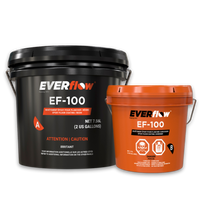
100 percent solids epoxy in standard and fast cure, so you can match the pot life to the slab temperature.
Polyaspartic topcoats
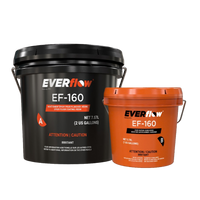
EF-275, EF-280 and EF-290, the topcoats the flake product pages call for.
Epoxy pigments
Colour for the base coat, which becomes part of the finish on a partial broadcast.
Grinders and tooling
Planetary grinders, cup wheels and segment tooling for the prep that decides the outcome.
Tools and accessories
Rollers, squeegees, spike shoes, scrapers and mixing gear.
If you would rather buy it assembled than pick it part by part, the garage kit collections group the base coat, pigment, topcoat, flake and tools for a given floor size: 1 car garage kit, 2 car garage kit and 3 car garage kit. Latux Epoxy is an authorized dealer for every brand it sells, so warranty, parts and technical support all run through us.
Working out how much to order
The flake side is the easy half, because the box coverage is published and it is in the table above. Measure the floor, decide full or partial, and read the row. On a full broadcast, round up. Running out of chip in the middle of a wet base coat is not a problem you can pause and solve, and a second box from a different production batch is not guaranteed to match the first.
The resin side depends on which base coat and which topcoat you are using, and those products have genuinely different coverage from each other, so a single figure here would be wrong for most readers. Use the coverage guide, which walks through film build, waste factor and kit maths for each product, and check the technical data sheet for whatever you have actually specified. If you would rather not do the arithmetic, call and we will build the material list layer by layer.
Two more things worth reading before you order. Installation tutorials walks through the broadcast and the scrape step. The finished job gallery shows what the blends look like on real floors rather than on a chip card, which is the closest you will get to a sample without holding one.
Spec it before you buy it
Tell us the floor and we will build the list
Square footage, slab condition, what the floor has to survive, and whether you want full or partial. That is enough for us to put the base coat, the chip and the topcoat on one list with nothing missing and nothing doubled up. We supply flooring contractors across South Florida and we ship UPS Ground free over $150, or you can collect it at the counter in Pompano Beach.