
Resinous Flooring: Systems, Chemistries and Supplies
Resinous flooring guide
Resinous flooring is any floor that goes down as a liquid, cures in place and bonds to the concrete under it. Epoxy, polyaspartic, polyurethane and urethane cement are all resinous floors. Latux Epoxy has supplied and installed them in South Florida since 2004. This is the plain-English guide: what each chemistry does, which build goes in which room, and how to spec one.
We supply and we install · Authorized dealer for every brand we carry · Contractor and distributor pricing · Local pickup in Pompano Beach · Free UPS Ground on orders over $150 · English, Spanish and Portuguese
Start here
What is resinous flooring?
A resinous floor starts as two or more liquid components. You mix them, pour or roll them onto prepared concrete, and a chemical reaction turns the liquid into a hard solid that is bonded to the slab. Nothing is laid in pieces, so there are no grout lines for dirt and water to sit in. Resin flooring, fluid applied flooring and pourable flooring are the same thing under other names: a floor made on site, not delivered in boxes.
Two families sit under that name. The first is a film: epoxy, polyaspartic or polyurethane coatings measured in mils, a mil being one thousandth of an inch. A 100% solids epoxy build coat is typically 10 to 20 mils. The second is a mortar: urethane cement placed at 1/8 to 3/16 inch, closer to a thin layer of new concrete than a coating. Either way, the resin is rarely what fails. The slab is: never ground to a profile, or still pushing moisture into the bond line.
The chemistries
Resinous floor coatings, one chemistry at a time
100% solids epoxy
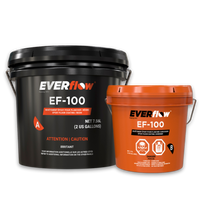
The base of most resinous flooring systems, and what people usually mean by epoxy resinous flooring or epoxy floor coatings. At 100% solids nothing evaporates, so it builds thick enough to fill slab texture and hold a flake broadcast or a metallic pour. Everflow EF-100 cures to 6,200 psi compressive and 5,500 psi tensile. Our own LTX-100 reaches 18,400 psi compressive and is rated for 10 to 32 mils per coat. Its weakness is sunlight. It ambers under UV, so it usually gets a topcoat.
Water-based epoxy
The hardware-store version: 30 to 50% solids, so half or more of it evaporates, at 2 to 3 mils per coat against 10 mils or more for a 100% solids kit. Fine for light duty, wrong for a shop or a plant. We do not stock water-based epoxy floor coatings. The one water-based product we carry, Premera Easy MVB, is a moisture vapor barrier primer that goes under the system, not a floor finish.
Polyaspartic and polyurea
The wear course. Aliphatic polyaspartic does not yellow, and it cures in hours. EF-290 is 90% solids, loses 0.03 g on the Taber abrasion test against 0.1 g for the EF-100 base, recoats in 2 to 4 hours and takes foot traffic in 3 to 6. EF-285 is a clear aliphatic polyurea with 40% elongation, used as a UV-stable primer or clear coat. On most floors you want both, epoxy underneath and polyaspartic on top. Full comparison: epoxy vs polyaspartic.
Polyurethane topcoats
EF-301 is an aliphatic polyurethane that cures to a satin finish at 35 gloss units and carries aluminum oxide for about 0.80 DCOF wet traction. It goes over a cured epoxy or urethane base, never bare concrete.
Urethane cement
The heavy end of resinous flooring. PPC Krete Slurry SL is a four-component polyurethane mortar placed at 1/8 to 3/16 inch. It is rated for service from 26.5F to 185F, publishes 9,050 psi compressive and 0% water absorption, and needs no slab moisture testing before it goes down. It is the floor for steam, hot wash-down and cold rooms. It costs several times what epoxy does and it is a trained-crew system. See the urethane cement flooring guide.
MMA (methyl methacrylate)
MMA is a resinous flooring chemistry known for curing very fast. We do not stock it. If a spec calls for it, tell us the room and we will say honestly whether a system above does the job.
System types
Resinous flooring systems by build
Chemistry is half the spec. The other half is how the floor is built up.
Thin film, roller coat
Primer, pigmented epoxy and topcoat, rolled or squeegeed. The cheapest resinous floor, and it shows every flaw in the slab.
Self-leveling and slurry
Poured thicker so it flows flat. Epoxy gives a glossy plane. Urethane cement slurry gives a matte, heat-resistant floor at 1/8 inch and up for food plants and kitchens.
Broadcast: flake and quartz
Aggregate thrown into a wet base coat, scraped, then sealed with a clear topcoat. Hides a tired slab and builds grip. See epoxy flake flooring for full and partial broadcast.
Metallic
Clear 100% solids epoxy tinted with metallic pigment and poured heavy. For showrooms and lobbies, finished with a UV-stable polyaspartic. Shop metallic systems.
Trowel and mortar
Heavier trowel-applied mortars for extreme thermal shock. Not on our shelf. If a room needs one, we source it.
Side by side
Resin flooring systems compared
Every number is from the product page or data sheet of the product in that row. Cure times at 68F unless noted.
| Chemistry | Build and cure | Heat and chemicals | UV | Typical use | Shop |
|---|---|---|---|---|---|
| 100% solids epoxy (EF-100) | Base coat. Recoat 18 to 24 hr, foot about 1 day, vehicles about 2 days, full cure about 7 days | Handles a great deal of shop and plant chemical exposure. The film debonds under steam and repeated thermal shock | Ambers in direct sun | Base coat, flake bed, warehouse and shop floors | Epoxy kits |
| Fast-cure epoxy (EF-155) | Recoat 2 to 4 hr, foot 6 to 8 hr. Applies on substrates down to 32F | As above | Topcoat with a UV-stable polyaspartic for sun | One-day flake and metallic builds, cold-weather work | EF-155 |
| Polyaspartic (EF-290) | 90% solids. Recoat 2 to 4 hr, foot 3 to 6 hr, vehicles about 1 day | Abrasion and chemical resistance over the color beneath, 0.03 g Taber loss | UV stable, non-yellowing | Wear course over epoxy and flake | Topcoats |
| Polyurethane (EF-301) | Final coat only. Foot about 1 day, vehicles about 2 days | 0.02 g Taber loss, strong chemical resistance | UV stable, satin | Satin, slip-resistant finish over epoxy or urethane | EF-301 |
| Urethane cement (PPC Krete Slurry SL) | 1/8 to 3/16 inch. Foot 12 hr, heavy traffic 24 hr, full chemical cure 5 days at 72F | Service 26.5F to 185F, thermal shock resistant, 0% water absorption | Topcoat is not color stable on ageing | Wash-down, kitchens, breweries, cold storage | Urethane cement |
| Water-based epoxy | 30 to 50% solids, 2 to 3 mils per coat | Not stocked, no data from us | Not stocked | Light-duty sealing only | Not stocked |
| MMA | Very fast cure | Not stocked, no data from us | Not stocked | Specialist fast-turnaround work | Not stocked |
Coverage is different for every product in a system, so work it per layer with the coverage guide and check the technical data sheets for whatever you actually specify.
Writing the spec
How to spec a resinous floor
Answer these five in order.
1. What lands on the floor, and how hot is it?
Oil, brake fluid and dry storage are epoxy territory. Steam, hot wash-down, boiling spills and freezer thresholds are urethane cement territory, because repeated thermal cycling is what pops an epoxy film off the slab, starting at the drains. Most plants split the spec: urethane cement on the wet side, epoxy on the dry side.
2. How wet is the slab?
Test it before you buy anything. The LTX-100 data sheet asks for internal relative humidity below 85% by ASTM F2170 and vapor emission below 3 lb per 1,000 sq ft per 24 hours by ASTM F1869 before it goes straight onto concrete. If the slab fails either test, a moisture vapor barrier goes down first. Urethane cement is the exception: PPC does not require moisture testing under Krete Slurry SL.
3. How long can you close the room?
A standard epoxy base wants 18 to 24 hours before recoat. EF-155 recoats in 2 to 4, and an EF-290 topcoat takes foot traffic in 3 to 6.
4. What rolls or drops on it?
Loaded forklift wheels crush a flake layer, so racking aisles want a thicker built epoxy with a polyaspartic wear course. Kegs, carts and dropped tooling in a wet room point to urethane cement at 3/16 inch. See warehouse floor coating.
5. Does it see sunlight, and does it get wet underfoot?
Epoxy in sunlight needs a UV-stable topcoat or it yellows. Wet floors need texture: a flake broadcast, aluminum oxide in the topcoat, or a silica broadcast at about 0.4 lb per sq ft on urethane cement.
Prep sits under all five. The coatings we stock call for mechanical prep, typically to ICRI CSP 2 to 3 by diamond grinding or shot blasting. Acid etching is not prep. The grinder buying guide covers machine sizing, and for commercial resin flooring, the commercial epoxy flooring page matches systems to rooms in more detail.
The alternatives
Resinous flooring vs tile, VCT and polished concrete
Tile and quarry tile. Hard wearing, but every grout line holds water and soil, and grout is where a wash-down floor fails. A resinous floor has no joints and turns up the wall as a cove base in wet rooms.
VCT. Cheap to lay, but it needs stripping and waxing, and it does not take standing water, hot tires or chemicals the way a resin floor covering does.
Polished concrete. Good on a sound slab in dry retail and warehouses. It is still bare concrete: it stains and hides nothing. Where the slab is poor or chemicals land on it, a resinous system is the better call.
Looking for pourable epoxy for a tabletop or river table? That is a different product. See the countertop and deep pour epoxy guide.
Buying the material
Resinous flooring supply from Latux
If you are looking for a resinous flooring supply house, our epoxy flooring supplies page lists everything we stock in one place: resin floor materials, flake, pigment, grinders, tooling and dust control. Everflow, our own LTX-100 and MONEY COAT lines, PPC and Premera cover every system on this page except water-based epoxy, trowel mortars and MMA.
- Epoxy kits, standard and fast cure
- Polyaspartic and polyurethane topcoats
- Urethane cement systems
- Metallic systems
- Flake and quartz systems
- Moisture vapor barrier
- Primers
- Floor grinders
We are an authorized dealer for every brand we carry. Contractor, Distributor and VIP trade tiers are applied to your account, so your pricing follows you at checkout without a code. Apply for a trade account. Free UPS Ground on orders over $150, charged by weight under that. Machines and urethane cement are quoted per job. Local pickup at our Pompano Beach counter is available on everything we stock.
Common questions
Resinous flooring questions we get asked
What is resinous flooring?
A floor mixed from liquid components on site, poured or rolled onto prepared concrete, and cured in place bonded to the slab. Epoxy, polyaspartic, polyurethane and urethane cement are all resinous floors.
Is resinous flooring the same as epoxy flooring?
Epoxy is one kind of resinous flooring, and the most common base coat. Most floors combine two chemistries: an epoxy base for bond and build, and a polyaspartic wear course on top.
How thick is resinous flooring?
Coatings are measured in mils, thousandths of an inch. A 100% solids epoxy build coat is typically 10 to 20 mils, and LTX-100 is rated for 10 to 32 mils per coat. Water-based epoxy goes on at 2 to 3 mils. Urethane cement is placed at 1/8 to 3/16 inch, roughly 125 to 190 mils.
How much does resinous flooring cost?
Prep, layers and chemistry drive it more than footage. A roller-coat epoxy system is the cheapest. Flake and metallic add material and labor. Urethane cement lands several times higher than epoxy per square foot. Send us the footage and we will price the material list.
Is resin flooring slippery?
A smooth gloss finish can be slippery when wet. The fix is texture in the system: a flake broadcast, a topcoat with aluminum oxide such as EF-301 at about 0.80 DCOF wet, or a silica broadcast at about 0.4 lb per sq ft into urethane cement.
Can resinous flooring go over a damp slab?
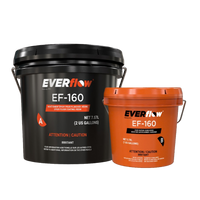
Not without a barrier. Test the slab. If it fails, prime with a moisture vapor barrier such as EF-160, rated to 25 lbs emission per 1,000 sq ft per 24 hours at 100% RH, and build the system on top. Urethane cement from PPC does not require moisture testing.
Where can I buy resinous flooring supplies?
Latux Epoxy is a resinous flooring supplier in Pompano Beach, FL, and an authorized dealer for every brand we carry. Free UPS Ground on orders over $150, or pick up at the counter.
Do you install resinous floors?
Yes, in Broward, Miami-Dade and Palm Beach counties. Outside those three, we work with a network of installers across the US. Call (800) 413-1427.
Speak to a coatings expert
Tell us the room and we will spec the floor
Latux Epoxy
2201 N Andrews Ave, Suite 108
Pompano Beach, FL 33069
(800) 413-1427
Monday to Friday, 8:00 AM to 5:00 PM.
Saturday by appointment.
Sunday closed.