
Epoxy Over Vinyl Tile and Linoleum
The short answer
Test the flooring for asbestos before anything else happens. If it comes back clear, coating over vinyl composition tile or linoleum is possible but it is rarely the best decision, and on a concrete slab pulling the flooring is usually cheaper than engineering around it. If it comes back positive, none of the prep on this page applies and the job belongs to a licensed abatement contractor.
Authorized dealer for every brand we carry · Contractor and distributor pricing · Local pickup in Pompano Beach · Free UPS Ground on orders over $150 · We speak English, Spanish and Portuguese
Stop and read this first
Older resilient flooring can contain asbestos
Resilient flooring installed before the 1980s, and some installed into the 1990s, can contain asbestos in the tile body, in sheet flooring backing, or in the black cutback adhesive underneath. Nine inch by nine inch tile is the classic indicator, but twelve inch tile and sheet linoleum are not automatically clear, and the adhesive can contain it even when the tile does not.
You cannot tell by looking. Only laboratory analysis of a sample collected by a licensed inspector can tell you what the material is.
If it is asbestos containing, everything this page says about grinding, sanding, scraping and blasting is exactly the wrong thing to do. Those methods make the material friable and release fibers into the air. Removal, encapsulation and disposal of asbestos containing flooring is regulated work for a licensed asbestos abatement contractor under federal and Florida rules. It is not a prep step on a coating job and it is not something to attempt because a video made it look simple.
Latux Epoxy supplies coatings and surface preparation equipment. We do not provide asbestos abatement services and we will not spec a grinding sequence over flooring that has not been tested. Test first. If it comes back positive, the abatement contractor goes before we do, and we will happily spec the coating for the bare slab they leave behind.
The substrate
Three materials people call the same thing
- Vinyl composition tile. A filled vinyl tile held together with plasticizers, laid in mastic, with a seam every twelve inches. Usually waxed, often several layers deep.
- Linoleum. Genuinely different material: linseed oil, resin, wood flour and cork on a jute backing. It is dimensionally sensitive to moisture and alkalinity from the slab below.
- Luxury vinyl plank and floating floors. Not bonded to the slab at all. They float, they expand and contract as a single sheet, and they move independently of everything under them. Do not coat a floating floor. There is no prep that makes this work.
What they share is that they are soft, sealed, seamed and stuck down with an adhesive that was never designed to carry a rigid coating and whatever traffic goes on top of it.
The failure mode
Four things that go wrong over resilient flooring
Plasticizer migration
The plasticizers that keep vinyl flexible do not stay put. They migrate into a coating applied over them, where they can keep the film soft, leave it tacky, or discolour it. This shows up weeks after the job and there is no fix from above.
Adhesive softening
Solvent in a coating can re-soften the old mastic under the tile. Once the adhesive goes soft, the whole assembly can shift under load and the coating goes with it. This is the failure that takes the floor rather than the finish.
Seam telegraphing
A twelve inch tile pattern means a seam roughly every twelve inches in both directions. The coating shrinks slightly into each one as it cures, and the grid reappears through the finish. Filling helps and does not eliminate it.
Trapped moisture
Resilient flooring and its adhesive have been sitting on the slab acting as a partial vapor retarder. Coat over the top and any vapor coming up now has nowhere to go but into the bond line between the tile and the mastic, which is already the weakest joint in the stack.
The recommendation
On a concrete slab, take it up
This is the page where the honest answer is least convenient. On a concrete slab, removing tested clear resilient flooring and its adhesive, then grinding to clean concrete, gives you a predictable substrate and a floor with a known life. Coating over it gives you a floor whose life is set by a mastic somebody spread decades ago.
Removal is more labor. It is also a job you do once. Once the slab is bare you are prepping concrete and every other page on this site applies normally.
The work
If you are coating tested clear tile anyway
- Confirm the test result in writing. Nothing mechanical starts before that.
- Strip the wax. Decades of floor finish is a bond breaker in its own right, and it has to be off before anything else means anything.
- Check that every tile is stuck. Anything loose, curled or drummy comes out, and the void gets filled flush.
- Abrade the face. Take the sheen off the whole surface, uniformly, with no glossy patches at the edges or in corners.
- Fill the seams. Bring the joints flush and let the filler cure before you go over it.
- Vacuum thoroughly.
- Do a test patch and wait. This is the step that matters most here. Coat a few square feet, let it cure fully, and check it for softness, tack and discolouration before you commit material to the whole floor. Plasticizer problems only show up after cure.
- Prime, then coat.
What to order
The material each step takes
| Step | What it does | What we stock |
|---|---|---|
| Grind to bare concrete after removal | The recommended route: removes adhesive and gives a known substrate | Floor grinders, cup wheels and diamond tooling |
| Control the dust | Adhesive and concrete dust both get captured at the head | Dust collectors and vacuums, dust extractors |
| Fill seams and voids | Brings tile joints and pulled tiles flush with the field | Everflow EF-135 crack filler |
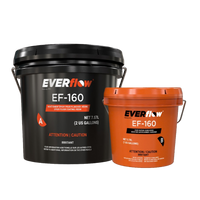
| Barrier, once the slab is exposed | The old flooring was a partial vapor retarder; the coating needs a real one | EF-160, moisture vapor barriers |
| Prime | Keys the build coat to the prepared surface | Premera FP1 fusion primer, primers |
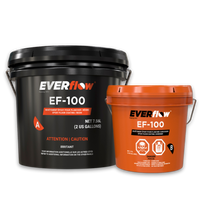
| Build coat | The structural layer over a known substrate | Everflow EF-100, epoxy kits |
| Wear course | Takes the abrasion and seals the system | Polyaspartic and polyurethane topcoats |
| Decorative broadcast | Hides seam shadow and residual substrate texture | Flake and quartz systems, flakes and quartz |
Sizing the job
Price the removal, then price the coating
Measure the floor and cost the removal separately from the coating, because the removal is where this job is won or lost. Once you know what substrate you are actually coating, run the kit math through the coverage guide and check each product's figures on the technical data sheets page.
Before you order
Related guides and the rest of the catalog
Talk to a supplier
Send us the floor, not just the square footage
Tell us what is on the slab now, what the moisture test said, and what the floor has to survive. We will spec the system layer by layer and build the material list.
Latux Epoxy
2201 N Andrews Ave, Suite 108
Pompano Beach, FL 33069
(800) 413-1427
Monday to Friday, 8:00 AM to 5:00 PM.
Saturday by appointment.
Sunday closed.