
Epoxy Over New Concrete
The short answer
Twenty eight days is the number everybody repeats, and it is a rule of thumb rather than a test. It describes strength gain, not dryness. A slab can be well past 28 days and still be too wet to coat, and the two things that actually decide the job are a moisture reading and whether a curing compound was sprayed on the day it was poured.
Authorized dealer for every brand we carry · Contractor and distributor pricing · Local pickup in Pompano Beach · Free UPS Ground on orders over $150 · We speak English, Spanish and Portuguese
Where the number comes from
28 days is a strength milestone, not a moisture one
Concrete is specified and tested at 28 days because that is when a standard mix has reached most of its design compressive strength. That is a useful thing to know and it is not the question a coating asks.
A coating asks how much water is still leaving the slab. Concrete only needs part of its mix water to hydrate the cement. The rest, the water of convenience that made the mix workable, spends months moving out through the surface. A thick slab, a slab poured over a vapor retarder, a slab in a humid climate or a slab in an unconditioned building all dry slower than the rule of thumb assumes.
So treat 28 days as the earliest you would even test, not as permission to coat.
The real gate
Three moisture tests, in order of how much they tell you
Plastic sheet, ASTM D4263
Tape a two foot square of clear sheeting flat to the slab, seal all four edges, leave it 24 to 48 hours. Condensation underneath or a dark patch on the concrete means vapor is moving. Free, fast, and a go or no go only. It gives you no number, and it can read clear on a slab that still fails a real test.
Calcium chloride, ASTM F1869
A weighed dish under a sealed dome for 60 to 72 hours, returning moisture vapor emission rate in pounds per 1,000 square feet per 24 hours. It measures the top half inch or so of the slab, which means a slab that has been dried at the surface can read better than it is.
In situ relative humidity, ASTM F2170
Probes set into drilled holes at 40 percent of slab depth, read after equilibration, returning internal relative humidity. This is the one that tells you what the slab will do once it is sealed, and it is the test to run when the floor matters.
The limits are product specific and they live on the data sheet, not in general advice. Every current sheet for what we sell is on the technical data sheets page. If the slab reads over the limit, that is not the end of the job. It means the system starts with a moisture vapor barrier.
The failure mode
The curing compound is the one that catches people
On most new pours the finishing crew sprays a membrane curing compound as they leave. Its entire job is to stop water escaping from the slab so the concrete hydrates properly. It does that job by forming a film on the surface.
That film is now sitting exactly where your coating needs to bond, and it is designed to be a barrier. Coat over it and the epoxy bonds to a thin membrane that is itself barely attached to the concrete, and the floor peels. It is the single most common new slab failure and it is entirely preventable, because the compound has to come off mechanically and grinding removes it as a matter of course.
Check for it with the water drop test. Put a few drops of water on the bare slab in several places. If they bead and sit, something is sealing the surface. If they darken and absorb within a minute or so, the concrete is open.
The other two
Laitance and burnishing. A power trowelled slab has a dense, closed, cement rich skin. It looks like the best surface on the job and it is the weakest, because it is a thin layer with poor cohesion sitting on the real concrete. Grinding removes it. Not grinding means your coating is bonded to a layer that can shear off.
Efflorescence and high pH. Green concrete is strongly alkaline, and moving moisture carries salts to the surface where they crystallise as a white powder. Salts at the bond line are a bond breaker, and high alkalinity attacks some coating chemistries. Both are reasons to test rather than to guess.
The work
The prep sequence for a green slab
- Wait, then test. Do not coat because a calendar said so. Run a real moisture test and read the number against the product data sheet.
- Water drop test for a curing compound or sealer. Several spots, including the middle of the floor and near the doors.
- Grind the slab. Diamond tooling to remove the curing compound, the laitance and the burnished skin, working to an open profile around ICRI CSP-2. On a new pour this goes quickly, because you are taking off a thin skin rather than a coating.
- Open the control joints and cracks. Deal with shrinkage cracks now, while the slab is bare and accessible.
- Vacuum. Grinding dust in the profile is a bond breaker.
- Barrier if the readings call for it. On a South Florida slab on grade, plan for this rather than hoping.
- Prime, build coat, wear course.
What to order
The material each step takes
| Step | What it does | What we stock |
|---|---|---|
| Grind off curing compound and laitance | Removes the sealed skin and the weak cement rich layer under it | Floor grinders, large and industrial grinders |
| Tooling | Diamond segments and cup wheels cut the profile | Turbo Supreme diamond cup wheel, cup wheels and diamond tooling |
| Control the dust | Keeps silica out of the air on an enclosed new build | Dust collectors and vacuums, dust extractors |
| Treat shrinkage cracks and joints | Handles them while the slab is still bare and reachable | Everflow EF-135 crack filler |
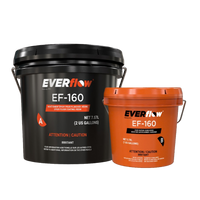
| Moisture vapor barrier | The step a green slab most often needs, and the one most often skipped | EF-160, Premera Easy MVB |
| Prime | Keys the build coat to freshly ground concrete | Premera FP1 fusion primer, primers |
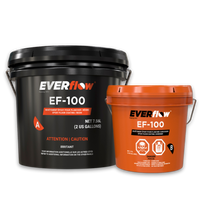
| Build coat | The structural layer that carries the traffic | Everflow EF-100, epoxy kits |
| Wear course | Abrasion resistance over the build, on a schedule that suits handover | Everflow EF-280, polyaspartic topcoats |
Sizing the job
Freshly ground concrete is thirsty
A newly ground slab is the most absorbent surface on this list, and the first coat disappears into it faster than any spec sheet written for a sealed floor suggests. Measure the footage, decide whether a barrier coat is in the stack, and run the kit math through the coverage guide. If you are specifying a machine for a new build rather than renting, the grinder buying guide covers sizing by footage and access.
Before you order
Related guides and the rest of the catalog
Talk to a supplier
Send us the floor, not just the square footage
Tell us what is on the slab now, what the moisture test said, and what the floor has to survive. We will spec the system layer by layer and build the material list.
Latux Epoxy
2201 N Andrews Ave, Suite 108
Pompano Beach, FL 33069
(800) 413-1427
Monday to Friday, 8:00 AM to 5:00 PM.
Saturday by appointment.
Sunday closed.